Free delivery on orders over CHF 50! *

Get 20% discount on products GladiatorFit with code NEW20

5 exercises to build up your shoulders

Who has never dreamed of having beautiful, square, well-shaped shoulders?

In fact, the shoulders are a muscle group appreciated by many bodybuilders because they give the upper body a broader structure. Developed shoulders also give the impression of a V waist and, through an optical effect, a slimmer waistline.

What’s more, did you know that the shoulder muscles are among the muscles of the body most in demand on a daily basis?

They come into play when we lift something over our head or when we pull or push with our arms. Pleasant to work, the shoulders are considered a large muscle and one of the most complex joints in the body, since they are made up of different fascicles. It is important not to neglect any beam in order to avoid injuries.

Why have muscular shoulders?

Well-muscled shoulders offer both aesthetic benefits, by improving physical appearance, and functional benefits, by enhancing stability and performance during movement.

Aesthetic advantages

Well-muscled shoulders contribute to an attractive physical appearance. They give the silhouette a more toned and balanced appearance, highlighting the upper body. Sculpted shoulders can also help create the illusion of a slimmer waist, improving overall body proportion.

Functional advantages

Well-muscled shoulders offer many functional advantages. They offer greater stability for shoulder joints, reducing the risk of injury and pain. Muscles developed in this area improve the ability to perform everyday movements such as carrying heavy objects, pushing, pulling or lifting. What’s more, strong shoulders improve performance in a variety of sporting activities, including throwing, swimming and bodybuilding.

Shoulder function

The shoulder, with its essential function in daily activities and its complex composition, plays a crucial role in our mobility and ability to perform a multitude of movements.

Everyday use

The shoulder is essential for everyday movements such as raising the arms, grasping objects, combing the hair, and so on. It enables great mobility and plays a key role in daily activities.

Complex composition

The shoulder is made up of several components, including the shoulder joint, clavicle, scapula and surrounding muscles. These complex structures work together to enable multidirectional movement and stability of the shoulder. This makes it a highly specialized joint.

Anatomie de l’épaule

Anatomy of the shoulder

The anatomy of the shoulder allows us to understand that a single exercise is not enough to strengthen this rather complex part of the body. If we analyze the shoulder, we can see that it is made up of three main fascicles.

The anterior bundle

It is located on the front of the shoulder. It is strongly solicited during the exercises of developed and gives thickness to the profile of the shoulder.

The medium beam

It is located on the side of the shoulder. It is activated when the arm is raised laterally. It gives volume to the shoulder and a rounded appearance.

The posterior bundle

It is located on the back of the shoulder. It is solicited during exercises where the elbows are pulled back.

Les élévations latérales pour se muscler les épaules

Lateral elevations

Description of the dumbbell, low pulley and elastic exercises

With dumbbells

  1. Choose a load that allows you to maintain good technique throughout the sets and reps.
  2. Take the two dumbbells and stand with your feet hip-width apart and your knees slightly bent.
  3. Hold the dumbbells at your sides, palms facing your legs and turned slightly inwards (a little pronation).
  4. Your arms should be straight but don’t lock your elbows, keep them slightly bent. All reps should start in this position.
  5. Raise both dumbbells until your elbows are horizontal, making sure you remain well sheathed.
  6. Palms should be facing the floor at the top of the movement.
  7. Pause for a moment, then descend in a controlled manner.
  8. Once you are back in the starting position, repeat until you reach the desired number of repetitions.

Read: tips for choosing your dumbbells

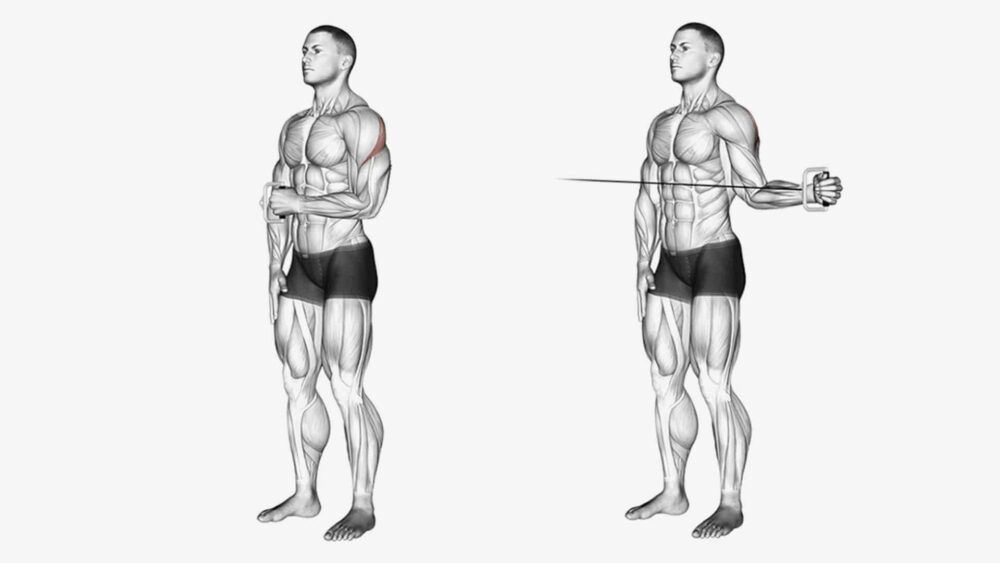
Low pulley

  1. Position yourself facing the low pulley, holding the handle attached to the pulley in one hand, with your arm extended alongside your body.
  2. Stand up straight with your feet shoulder-width apart to maintain your balance.
  3. Contract your abdominal and back muscles to stabilize your body during the exercise.
  4. Start the lateral lift by lifting the handle to the side, keeping your arm slightly bent and controlling the movement.
  5. Climb until your arm is parallel to the ground, keeping your elbow slightly higher than your wrist.
  6. Hold the contraction for a second to fully engage your shoulder muscles.
  7. Slowly return the handle to the starting position, controlling the movement.
  8. Repeat the movement for the desired number of repetitions, then switch sides if you’re doing the exercise with both arms.

With rubber bands

  1. Stand with your feet shoulder-width apart and place the center of the rubber band under both feet.
  2. Grasp the ends of the elastic band in each hand, palms facing inwards.
  3. Keep your arms at your sides, elbows slightly bent.
  4. Begin the lateral lift by simultaneously raising your arms to your sides until they are parallel to the ground.
  5. Keep your elbows slightly bent throughout the movement to avoid putting too much strain on the joints.
  6. Contract your shoulder muscles for a second at the top of the exercise to maximize the effort.
  7. Slowly lower your arms back to the starting position, controlling the resistance of the rubber band.
  8. Repeat the movement for the desired number of repetitions, maintaining good posture and controlling the movement with each repetition.

Tips for carrying out the exercise correctly

Lateral lifts can be performed with dumbbells, low pulley and elastics. It is important not to raise your arms above the shoulder line.

Les développés pour se muscler les épaules

The developed

Introduction to different types of push-ups (military, seated with barbell or dumbbells)

Push-ups are a basic exercise for building shoulder strength. There are various bench press exercises such as military presses, seated barbell presses or dumbbell presses.

Military developments

  1. Start by standing with your feet shoulder-width apart.
  2. Hold a barbell with a grip slightly wider than shoulder-width apart, palms facing forward.
  3. Lift the bar onto your shoulders, bending your elbows slightly and placing the bar just above your chest.
  4. Keeping your abs contracted and your back straight, push the bar upwards by stretching your arms.
  5. Keep pushing until your arms are fully extended above your head.
  6. Pause for a second at the top to engage your shoulder muscles.
  7. Slowly lower the bar back to the starting position, bending your elbows.
  8. Repeat the movement for the desired number of repetitions, maintaining good form and controlling the movement with each repetition.

Seated barbell push-ups

  1. Sit on a flat bench with your back straight and your feet firmly planted on the floor.
  2. Place the loaded bar on the rack supports at an appropriate height, just above your chest.
  3. Grasp the bar with a grip slightly wider than shoulder-width apart, palms facing forward.
  4. Lift the bar off the supports and bring it up to chest height, with arms bent and elbows pointing forward.
  5. Keeping your back straight and your abdominals contracted, push the bar upwards by stretching your arms.
  6. Keep pushing until your arms are fully extended above your head.
  7. Pause for a second at the top to engage your shoulder muscles.
  8. Slowly lower the bar to the starting position by bending your elbows and bringing the bar up to your chest.
  9. Repeat the movement for the desired number of repetitions, maintaining good form and controlling the movement with each repetition.

Dumbbell sit-ups

  1. Grab the dumbbells and place them on your lap if you are doing the bench version.
  2. With a controlled movement, lift the dumbbells to the starting position, i.e. at ear level. The palms of your hands should be facing forward.
  3. Take a deep breath and push the dumbbells over your head while stretching your arms and contracting your deltoid muscles.
  4. Slowly lower the dumbbells to the starting position.
  5. Repeat the movement until you have completed the required number of repetitions.

Tips for carrying out the exercise correctly

No matter which exercise you choose, it is important not to go below the ears and to take care in the execution of the movement.

Rotation externe à la poulie

External rotation at the pulley

Importance of working the shoulder’s external rotator muscles

The external rotator muscles of the shoulder are much smaller than the internal rotator muscles of the shoulder (the pectorals and the dorsal muscles), so they should not be forgotten. They are essential for pushing movements such as the bench press and the military press and in particular to improve strength in this area.

Tips for carrying out the exercise correctly

  1. Adjust the height of the pulley to the height of your elbow.
  2. Stand with your right side facing the pulley you will be working with.
  3. Grab the pulley with your left arm and bend your elbow at a 90 degree angle while keeping your arm firmly against your left side.
  4. Pull the pulley to the left to externally rotate the shoulder.
  5. Hold this position for about two seconds.
  6. Return the forearm to the starting position.
  7. Repeat this movement until you have completed the desired number of repetitions.
  8. Follow this series with the right arm.
Le tirage menton

Chin-up

Exercise objective for lateral deltoids and shoulder width

The chin-up rowing is an exercise that targets the lateral deltoids which gives a width effect to the shoulders. This can help reduce the width of your waist, while toning and shaping your upper shoulders.

Tips for carrying out the exercise correctly

  1. Grab a barbell with a grip slightly less than shoulder width. Think about sheathing your entire body.
  2. Lift the bar until your elbows are level with your shoulders. During the movement, it is important to keep the bar under control; keep it close to your body.
  3. Pause at the top for about two seconds before returning it to the starting position.
  4. Repeat the operation for the desired number of repetitions.
L’exercice de l’oiseau en musculation

The bird

Targeting the back of the shoulders

The bird is a strength training exercise that targets the back of the shoulders. In many people, this part is underdeveloped and this exercise is very interesting to obtain a harmonious muscular development of the shoulders.

Tips for carrying out the exercise correctly

Sitting on a bench (recommended to avoid injuries)

  1. Stand on a flat bench and grab a pair of dumbbells.
  2. Sit up straight, then tilt forward from the hips.
  3. Keep your arms at your sides with a neutral grip, dumbbells at your calves.
  4. Take a breath and bring the dumbbells upwards, mobilizing the rear deltoids.
  5. Try to pause briefly to take advantage of the maximum tension on the deltoids, then slowly descend to the starting position while maintaining control of the movement.
  6. Repeat this sequence until you have completed the desired number of repetitions.

Complete shoulder workout

Training plan including the above exercises

Here is an example of a training plan including the exercises mentioned:

  1. Military bench press: Basic shoulder exercise that involves pushing a barbell or dumbbell upwards, targeting the deltoids and upper back muscles.
  2. Pulley external rotation: Exercise to strengthen the external shoulder muscles using a pulley to perform rotational movements, thus improving joint stability.
  3. Front raises (Super Set): Combined training of the anterior deltoids with front raises using dumbbells or an EZ bar, strengthening the front part of the shoulders.
  4. Lateral raise (Super Set): Exercise targeting the lateral deltoids by lifting the arms to the sides, strengthening shoulder width and improving aesthetics.
  5. Bird: Isolated exercise for the posterior deltoids and upper back muscles, performed by spreading the arms to the sides to stimulate development of the mid-back muscles.
  6. Chin pull: Exercise for the upper back muscles, involving pulling a bar or rope towards the chin, strengthening the trapezius and posterior deltoids.

Recommended number of sets and repetitions

Here are the recommendations for the number of sets and repetitions for each exercise:

  • Military bench press: 3 sets of 10 repetitions
  • Pulley external rotation: 4 sets of 10-12 repetitions on each side
  • Frontal raising (Super Set): 3 sets of 10 repetitions
  • Lateral raising (Super Set): 3 sets of 10 repetitions
  • Bird: 3 sets of 10 repetitions
  • Chin-up: 4 sets of 10 repetitions

In conclusion, comprehensive shoulder training is essential to develop well-muscled shoulders, both aesthetically and functionally. By working the different muscles of your shoulder in a balanced way, you’ll improve the stability, mobility and strength of this key joint. Don’t forget to adapt loads, sets and repetitions to your level of fitness, and to include a good recovery period to allow your shoulders to develop and strengthen progressively. .

Discover a selection of GladiatorFit products suitable for these exercises

GladiatorFit offers you a whole range of products to help you perform these exercises. Below is a list of articles we recommend to help you carry out your session as efficiently as possible.