


- Sports tips
Exercises with a barbell
Exercising with a weight bar offers a multitude of benefits for those looking to improve their fitness and strengthen their upper and lower limb muscles. By simply using a barbell, you can perform most basic bodybuilding exercises, providing a complete and versatile workout. This method is particularly effective for those who want to tone their muscles and improve their cardiorespiratory capacity without having to use heavy weight training equipment.
The main advantage lies in the possibility of performing relatively long sets, lasting around 30 seconds, with a lightly loaded bar equivalent to 30-60% of its maximum capacity. This targeted approach makes it possible to achieve muscle toning objectives while avoiding unwanted mass gain. What’s more, the weight bar’s simplicity means you don’t need sophisticated equipment to succeed with your exercises.
In this article, you’ll discover the different exercises you can do with a weight bar, as well as techniques for optimizing your workout without heavy accessories. This offers an accessible and effective alternative for achieving your fitness goals.
The benefits of training with a barbell
Training with a weight bar offers a versatile and effective approach to improving fitness and strengthening upper and lower limb muscles. By simply using a barbell, a multitude of basic muscle-building exercises can be performed, effectively targeting the whole body. In addition to its benefits for muscle toning and cardio-respiratory capacity, there are several undeniable advantages to using a weight bar.
Overall muscle strengthening and stimulation of stabilizing muscles
The use of a weight bar in training optimizes overall muscle strengthening. Exercises such as squats, bench presses, deadlifts and pull-ups involve several muscle groups simultaneously. This allows us to work in a complete and balanced way. What’s more, training with a bar requires extra effort to maintain balance and stability during movements. This stimulates the stabilizing muscles. This strengthens not only the main muscles, but also the smaller muscles that support and protect the joints, reducing the risk of injury.
Opportunity to progress by increasing workload
Another advantage of training with a barbell is the ease of progression. By using graduated weight discs, you can gradually increase the workload. This progression constantly challenges the muscles, pushing them to adapt and grow. Progressive increases in load are essential for continued muscle growth and improved overall strength. It also offers a greater variety of exercises and levels of difficulty, tailored to individual needs. This allows athletes to improve and reach new goals as they progress.
Functional training for better performance in everyday life
Training with a weight bar promotes functional training, i.e. exercises that simulate the movements and activities of daily life. Unlike some body-building equipment that isolates muscles, using a barbell stimulates muscles in a coordinated way, better reflecting the real gestures of everyday life. This translates into improved functional performance, such as lifting heavy objects, climbing stairs or carrying loads. Functional training with a bar develops the strength, coordination and mobility needed to perform these tasks with ease, and reduces the risk of injury in everyday life.
6 exercises to build full-body muscle with a barbell

Squat: muscle-strengthening exercise for the lower limbs and abdominal muscles
The squat is an essential muscle-strengthening exercise for the lower limbs and abdominal belt. Focusing primarily on the quadriceps, this exercise also works the hamstrings, glutes, back and abdominals, providing a complete lower-body workout. This functional exercise improves leg strength and stability, promoting better posture and increased performance in a variety of sporting and everyday activities.
To perform an effective squat:
- Place the bar behind your neck, at the level of the upper trapezius, while keeping your feet shoulder-width apart, slightly tilted outwards.
- As you inhale, bend your legs until your thighs are horizontal, then rise as you exhale.
- Make sure that your knees do not extend beyond the balls of your feet when bending, to avoid undue stress on your joints.

Deadlift: a complete exercise for several muscle groups
The deadlift is a complete and versatile exercise that calls on several muscle groups simultaneously. Focusing primarily on the hamstrings, this exercise also engages the back muscles, glutes, quadriceps, arms and abdominals. It’s essential to master the correct technique to avoid injury and reap the full benefits of this all-round exercise. Integrating the deadlift into your training routine will enable you to develop balanced, high-performance muscles for your daily activities and sports.
To perform an effective deadlift :
- Stand in front of the bar on the floor, feet shoulder-width apart, and grasp it with your outstretched arms.
- Inhale deeply, hold your breath and lift the bar, keeping your lower back straight.
- Make sure the bar follows a straight trajectory as you extend your knees and hips.
- At the height of the movement, exhale.
- Then lower the bar in a controlled manner, keeping your back straight.
Read more: Complete workout to develop your glutes
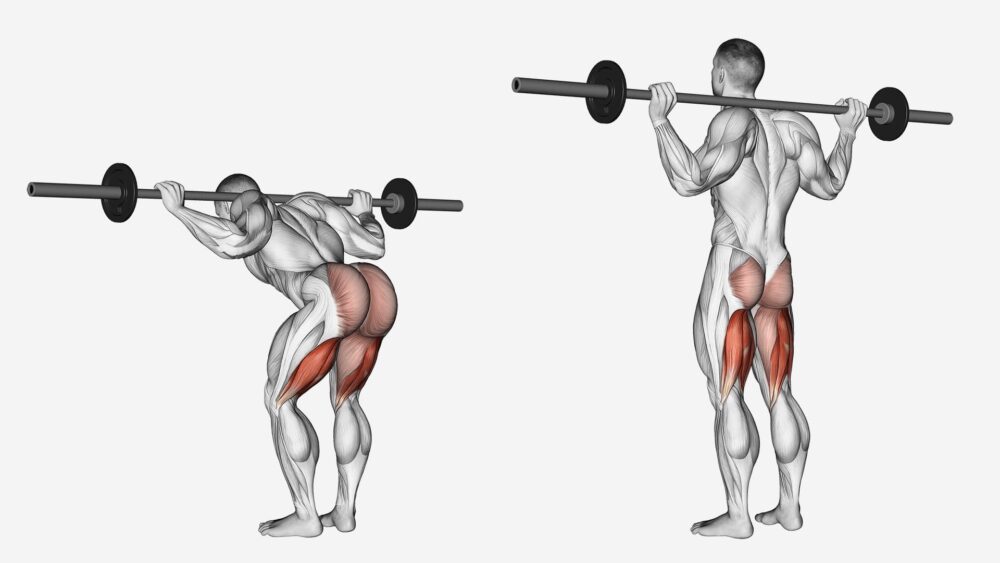
Good morning: exercise targeting the glutes, hamstrings and abdominal muscles
The “Good morning” exercise is an excellent option for specifically targeting the glutes, hamstrings and abdominal muscles. This exercise intensely stimulates the muscles of the lower body while engaging the abdominals to maintain a stable position and protect the lower back. It is essential to master the right technique to maximize results and minimize the risk of injury. Incorporate this exercise into your workout routine for powerful legs and glutes, while strengthening your core stability.
To achieve an effective “Good morning”:
- Place the barbell behind your neck, at the level of the upper trapezius, in a position similar to that of the squat.
- Standing with feet shoulder-width apart, contract your abdominal muscles and slowly lean forward from the hips.
- Make sure you push your hips back while keeping your back flat.
- Flex your quadriceps and glutes while maintaining control of the movement.
- Then slowly return to the starting position, straightening your torso.

Chin-up: exercise for deltoids and trapezius
The vertical chin pull is a widely adopted bodybuilding exercise for effectively targeting your deltoids and trapezius muscles. This exercise is particularly effective for building strength and muscle mass in your shoulders and upper back. By targeting your deltoids, it helps improve the width and definition of your shoulders, while work on your trapezius muscles promotes better posture and a more athletic appearance. The chin-up pull is a valuable addition to your workout routine aimed at strengthening your upper body and sculpting a balanced figure.
To perform an effective chin-up pull:
- From a standing position, grasp the bar with outstretched arms, hands pronated and close together, slightly narrower than shoulder-width apart.
- As you inhale, pull the bar upwards, keeping close to your body.
- Focus on raising your elbows rather than your hands, to give your deltoids and trapezius a good workout.

Military bench press: exercise for shoulders, pectorals and upper back
The military bench press is a versatile exercise that calls on several muscle groups, including your shoulders, pectorals, upper back, triceps and abdominal muscles. This complete exercise strengthens your upper body muscles, improves shoulder stability and promotes better posture. By targeting several muscle groups at the same time, the military bench press is effective for developing strength, power and overall upper-body coordination. It is essential to maintain good technique to avoid injury and maximize the benefits of this exercise. Incorporate the military bench press into your training program to achieve sculpted shoulders and a strong, balanced upper body.
For effective military development:
- Standing with your feet hip-width apart and your torso and back straight, grasp the bar in a pronated grip, your hands spaced slightly wider than shoulder-width apart.
- Place the bar on your upper chest and lift it above your head with a full vertical extension of your arms.
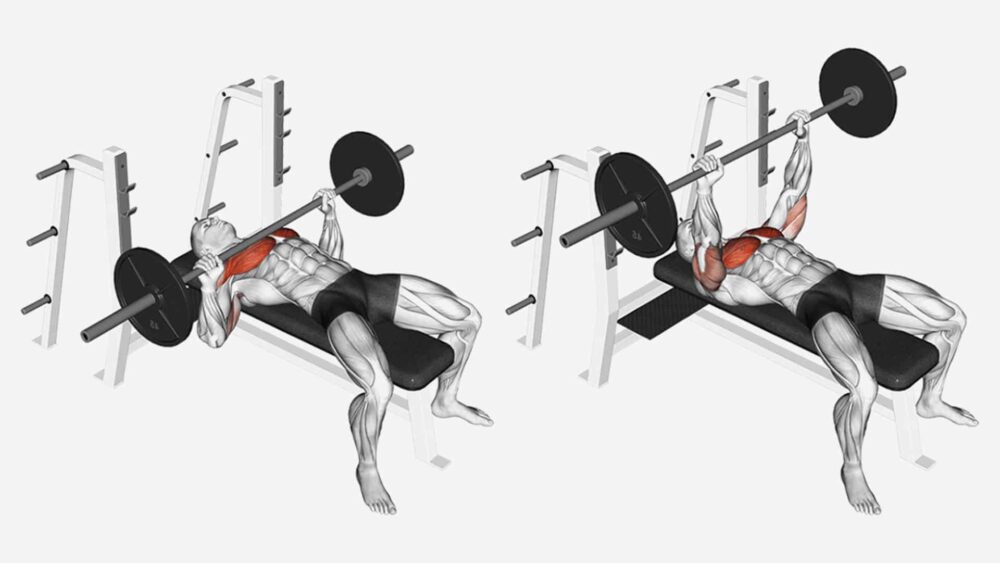
Bench press: multi-joint exercise for pectorals, triceps and shoulders
The bench press is an essential polyarticular exercise that primarily engages your pectoral muscles, while also engaging your triceps and shoulders in a secondary way. This complete exercise goes beyond working your upper-body muscles, also involving your legs for optimum stability, sheathing your abdominal muscles and stabilizing your shoulder girdle. By targeting several muscle groups at the same time, the military bench press is effective for developing strength, power and overall upper-body coordination. It is essential to maintain good technique to avoid injury and maximize the benefits of this exercise. Incorporate the military bench press into your training program to achieve sculpted shoulders and a strong, balanced upper body.
To perform the bench press effectively :
- Lie down on a bench and grasp the bar with your arms stretched out above your face, hands pronated and more than shoulder-width apart.
- Inhale, then lower the bar in a controlled manner to your chest.
- As you exhale, push the bar to return to the starting position.
Tips for safe and effective barbell exercise
- Warm-up: Before starting any workout with the weight bar, warm up properly. Perform dynamic movements to increase blood circulation, warm up your joints and prepare your muscles for exertion.
- Correct technique: Technique is key to avoiding injury and maximizing results. Learn the correct form for each exercise with the weight bar by enlisting the help of a coach or watching reliable tutorials.
- Gradual progression: Don’t overload the bar right from the start. Gradually increase the workload to allow your body to adapt and strengthen itself safely.
- Breathing: Keep breathing properly during exercise. Exhale when you exert yourself and inhale when you relax.
- Posture maintenance: Maintain correct posture throughout the exercise to avoid back or joint injuries. Engage your stabilizing muscles to maintain a solid, stable position.
- Rest and recovery: Give your body time to recover between training sessions. Recovery is essential for muscle growth and injury prevention.
- Use of safety equipment: If you use heavy discs, consider using clamps to prevent the discs from slipping during exercise.
- Hydration and diet: Drink enough water before, during and after training, and eat a balanced diet to provide your body with the energy it needs for physical exertion.
- Listen to your body: If you feel pain or discomfort, stop exercising and consult a health professional if necessary.
- Variation of exercises: To avoid monotony and promote continuous progress, vary the exercises with the weight bar by including different movements and training angles.
Discover a selection of GladiatorFit products suitable for these exercises
GladiatorFit offers you a whole range of products to help you perform these exercises. Below is a list of articles we recommend to help you carry out your session as efficiently as possible.


