


Mini dumbbells: buying guide and home exercises
If you’ve decided to take control of your fitness without turning your living room into a commercial weight room, you’ve come to the right place. Mini dumbbells are undoubtedly the perfect allies for sculpting your body, improving your muscular endurance and optimizing your at-home sessions. Often underestimated in favor of very heavy weights, these small pieces of equipment are nonetheless brimming with unsuspected benefits, whether you’re a seasoned athlete in the recovery phase or a beginner looking to tone up gently.
In this comprehensive guide from your Swiss GladiatorFit expert, we’ll help you understand why these featherweights deserve a special place in your sports routine. You’ll discover how to select the right loads, which materials to use to guarantee your safety, and above all, how to use them effectively through practical exercises. Let us help you transform your approach to training with the right fitness equipment.
Why incorporate mini dumbbells into your workout?
Contrary to popular belief, it’s not always necessary to lift dozens of kilos to achieve visible, lasting results. Using lighter weights is part of an overall approach to health, well-being and functional performance.
The perfect accessory for fitness and rehabilitation
Versatility is the key word when it comes to this type of load. Incorporating small weights into your routine allows you to target deep stabilizing muscles that are often overlooked when training with heavy guided machines. In yoga or pilates, for example, adding light resistance intensifies work on the core (abdominal muscles) and improves balance.
It’s also an essential tool for specific warm-ups, particularly in crosstraining. Before tackling loaded bars, use small loads to wake up the shoulder rotator cuff and lubricate the joints without traumatizing them. What’s more, as part of sports rehabilitation following an injury, physiotherapists almost systematically recommend working with loads ranging from 0.5 to 3 kg to gently reweave muscle fibres and regain mobility.
The ideal choice for clutter-free training at home
The main obstacle to working out at home is often lack of space. Conventional weight stations or squat racks require a dedicated room. That’s where compact dumbbells come in, revolutionizing the way you work out. They slip easily under a bed, into a drawer or into a small decorative basket in the corner of the living room.
As well as being practical, they’re also reassuring. Training at home with very heavy weights without a spotter can be intimidating and risky. With light weights, you retain total control over your movements, perfect your technique and can train in complete safety, even if you’re alone in front of your screen following a video program.
How to choose the right pair of mini dumbbells?
At GladiatorFit.ch, we offer a wide range of equipment to meet your specific needs. However, with so many options to choose from, it’s essential to know the key criteria for making the right purchase. The material and shape of your weights will greatly influence your comfort of use.
Coating: neoprene or vinyl dumbbells
The material used to cover your weights is crucial, especially for home use. We strongly advise you to opt for neoprene dumbbells. This synthetic rubber coating offers many advantages:
- Non-slip grip: Unlike cast iron or chrome steel, which slip as soon as your hands get clammy, neoprene ensures an exceptional grip, even when you’re sweating profusely during an intense cardio session.
- Protection for your floor: if a dumbbell slips out of your hand, the coating absorbs the impact, protecting your parquet or tiles from scratches and cracks.
- Thermal comfort: unlike metal, which can be cold to the touch in winter, neoprene or vinyl remain pleasant to grip at any time of year.
- Easy maintenance: Simply wipe clean with a damp cloth and stand up to the wear and tear of time.
Form: Hexagonal dumbbells are the way to go
If you look closely at our catalog, you’ll notice that many of our models feature hexagonal heads. This is no mere aesthetic choice! Hexagonal dumbbells are designed not to roll on the floor when placed.
This feature is a real safety guarantee for training at home. Finis the weight that inadvertently rolls under your foot while you’re skipping rope or doing burpees. What’s more, this flat face means you can use your dumbbells as real push-up bars to perform push-ups or dynamic bodyweight exercises without breaking your wrists. It’s a detail that increases the possibilities of your workout tenfold.
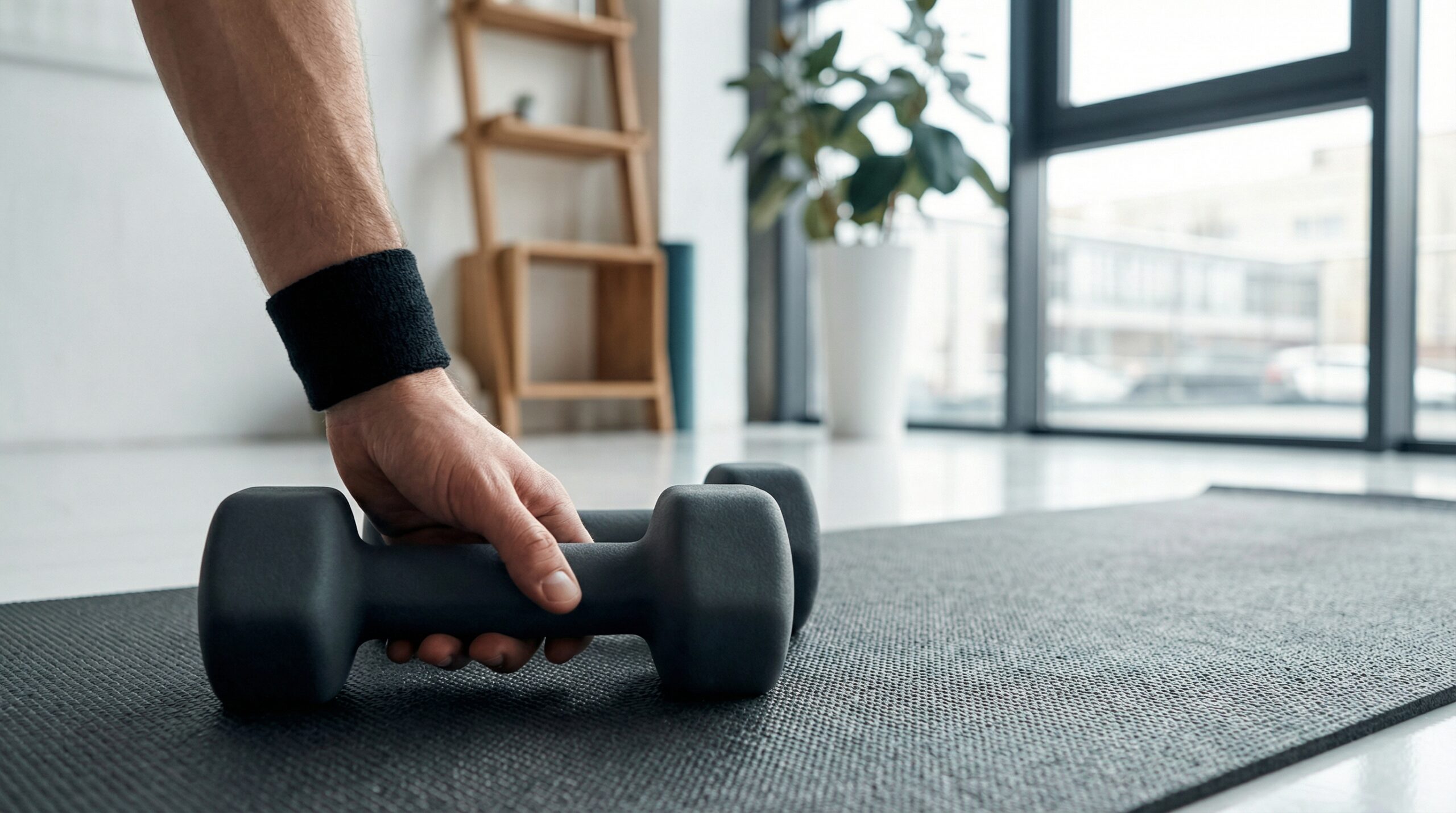
What weight should you choose for your dumbbells?
The most common mistake when buying a dumbbell kit is to overestimate or underestimate your capabilities. The ideal weight depends fundamentally on your level of practice and, above all, the objective of your workout. Here are our expert recommendations to help you slip the right weight into your GladiatorFit basket.
From 0.5 kg to 2 kg: for cardio and mobility
These extremely light weights may make gym-goers smile, but when used properly, they’re frighteningly effective. They’re for you if :
- You practice shadow boxing and want to increase your cardiovascular intensity and arm speed.
- You do choreographed fitness sessions, aerobics or power walking.
- You’re undergoing joint rehabilitation for your shoulder or wrist.
- You perform isolation exercises targeting small muscles with very long sets (over 20 repetitions) to create an intense metabolic burn.
From 2.5 kg to 5 kg: for muscle strengthening
This is the ideal category to start toning and sculpting your figure. These weights are ideal for total-body work and for beginners who are just starting out in home strength training.
- They are suitable for upper-body work: biceps curls, triceps extensions, military press-ups.
- They can be used to weight down exercises targeting the lower body: goblet squats, lunges, straight-leg deadlifts.
- They’re perfect for bodyweight crosstraining circuits that you want to harden up gradually.
Our advice: if your budget allows, don’t hesitate to buy two different pairs (for example, a 1 kg pair and a 3 kg pair). This will ensure steady progress and enable you to adapt the load according to the muscle group being worked (legs being naturally stronger than shoulders).
Three simple exercises with dumbbells
Now that you know how to choose your equipment, it’s time to take action. With a simple pair of small weights, it’s perfectly possible to achieve a “full body” workout. Here are three fundamental movements you should incorporate into your routine.
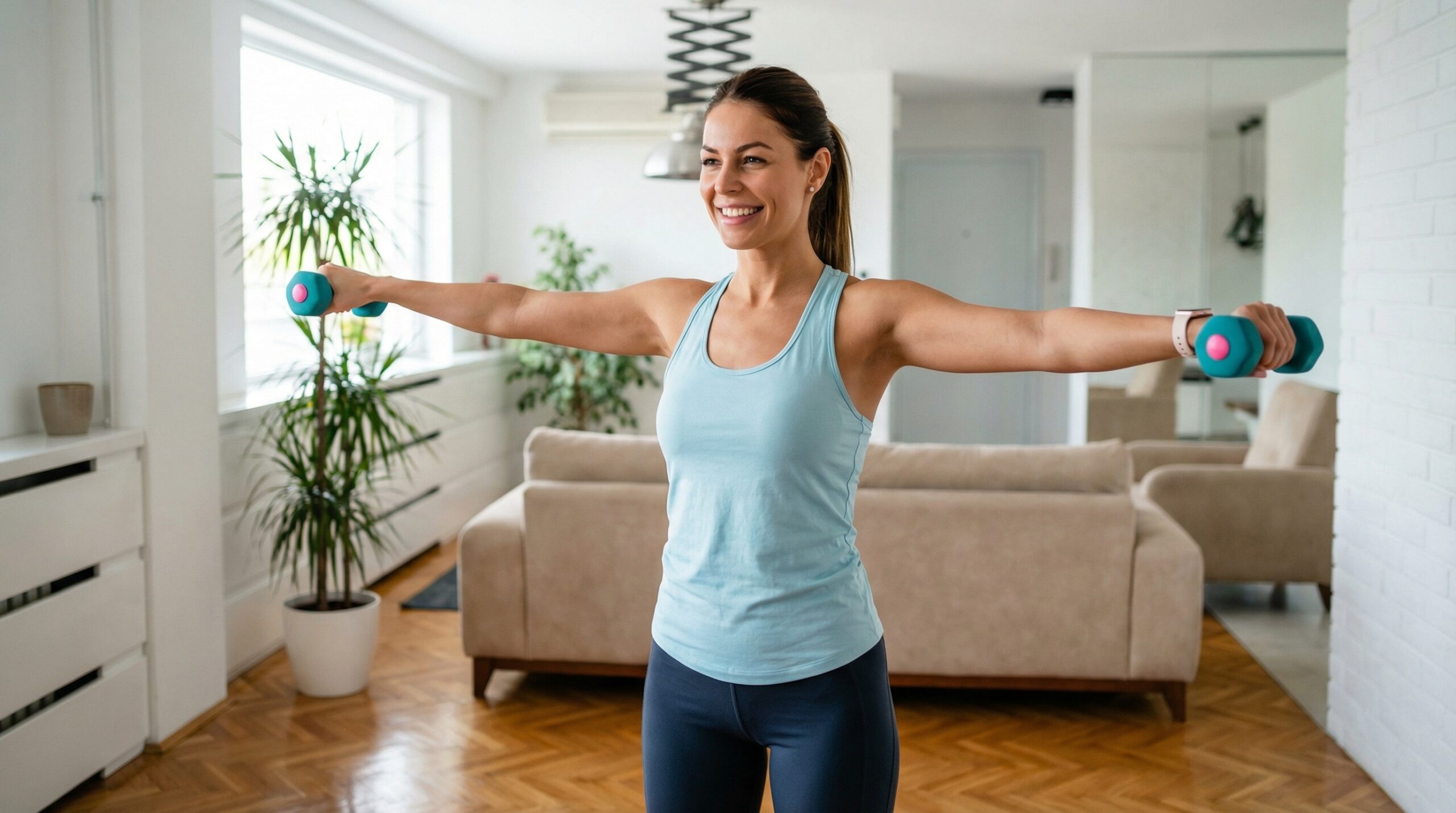
Lateral raises to sculpt shoulders
It’s the ultimate exercise for developing shoulder curvature (the middle fascicle of the deltoid) and achieving that sought-after athletic build. With light weights, execution takes precedence over load.
- Stand with feet hip-width apart, knees slightly bent to protect your back.
- Grab a dumbbell in each hand, arms at your sides, palms facing your thighs.
- Keeping your elbows very slightly bent, raise your arms to your sides until they are parallel to the ground (shoulder height, no higher).
- Controls the descent to return to the initial position by resisting gravity.
GladiatorFit tip: Don’t jerk your torso. The movement should be fluid and controlled. Aim for 3 to 4 sets of 15 to 20 repetitions to feel real muscle congestion.
Vacuum boxing to boost cardio
Excellent for burning maximum calories in minimum time, this exercise stimulates cardio while strengthening arms, shoulders and abdominal muscles.
- Adopt a boxing guard posture: one foot slightly forward, knees soft, fists (with your weights of 0.5 to 2 kg maximum) at face level.
- Throw jabs (straight punches in front of you), alternating left and right arms.
- Accompany the movement with a slight rotation of your shoulders and pelvis to engage your obliques.
- Maintain a fast, steady pace, but don’t lock your elbows violently at the end of the stroke to protect your joints.
GladiatorFit tip: Perform this exercise in intervals (e.g. 30 seconds of intense effort, 30 seconds of recovery) for 5 to 10 minutes.
Weighted lunges to tone the lower body
Lunges are ideal for strengthening the quadriceps and hamstrings, and shaping the glutes. Adding a moderate load optimizes muscle recruitment in your lower limbs.
- Stand with your chest upright, a dumbbell in each hand and your arms relaxed at your sides.
- Take a large step forward with your right leg.
- Bend both knees simultaneously to lower your pelvis towards the floor. Your back knee should touch the ground, and your front knee should form a 90-degree angle (without going beyond the ball of your foot).
- Push explosively on the heel of your front leg to return to the starting position.
- Alternate with the left leg.
GladiatorFit tip: Keep your gaze straight ahead and your abdominal muscles contracted throughout the movement to ensure balance.
Frequently asked questions: everything you need to know about mini dumbbells
What weight should I use to begin?
To get off to a good start, the choice of weight depends on the exercise in question. For upper-body strengthening (arms, shoulders), we generally recommend starting with dumbbells of between 1 kg and 2.5 kg for women, and between 2.5 kg and 5 kg for men. For the lower body (squats, lunges), you can add a further 1 to 2 kg. The initial aim is to learn to perform the movement with impeccable technique before seeking to increase the load. If you can do 20 reps easily, it’s time to move up a weight.
Is a 2.5 kg dumbbell suitable for beginners?
Absolutely! A 2.5 kg dumbbell is often considered the “Swiss Army knife” weight for beginners. It’s light enough not to compromise your posture on technical exercises targeting small muscles (like lateral raises or extensions for the triceps), but it offers enough resistance to start creating interesting muscle stimulus on polyarticular exercises. It’s an excellent investment for getting to grips with resistance training at home without risking injury.
Is it a good idea to do dumbbells every day?
Daily training with dumbbells is not recommended if you’re working the same muscle groups intensively every day. Muscle strengthening causes micro-tears in your fibers, and it’s on rest days that your muscles rebuild, tone and gain strength. However, if you’re using very light weights for cardio, mobility or active rehabilitation, moderate daily practice is possible. For a classic strengthening program, opt for 3 to 4 sessions a week, alternating the target areas (upper body one day, lower body the next) to give each muscle group at least 48 hours of recovery time.
Discover our selection of sports equipment
Find all the equipment you need to reach your goals on GladiatorFit.ch

Other articles
Newsletter
Receive our fitness tips and exclusive offers


