


Floor gymnastics equipment: equipment guide
Would you like to transform a room in your house into a real training area without cluttering it up with heavy professional structures? Then you’ve come to the right place. Contrary to popular belief, you don’t need to turn to the huge, overpriced apparatus of clubs and schools to practice effectively. The secret lies in choosing floor gymnastics equipment that’s suitable for home use, versatile and, above all, safe.
Whether you’re a crosstraining enthusiast looking to perfect your bodyweight movements, a fitness enthusiast or simply an athlete looking to improve your flexibility and agility, creating your own home gym is an excellent initiative. Finis scheduling and travel constraints, your practice space awaits you at home. The aim of this article is to guide you step-by-step in your choice of sports equipment. From the essential protective surface for your joints to the smallest fitness accessories, discover all our tips for setting up your ideal training area with the affordable, high-performance solutions offered by GladiatorFit.ch.
Essential equipment for floor gymnastics
The basis of all gymnastics and acrobatics is the security of your supports and landings. Without a solid, reassuring foundation, it’s impossible to fully commit to learning new movements or daring to push your limits.
Choosing the right gym mat
When it comes to gymnastics, the first thing that springs to mind is the surface you’re working on. But be careful not to confuse a simple yoga mat with a real gym mat. Yoga and Pilates require very thin mats to feel the ground beneath your feet, whereas gymnastics imposes much more intense physical constraints.
To absorb the shock of your acrobatics, jumps and landings, you need volume and absorption. The choice of a good mat is based on two major criteria: its thickness and the density of its foam. A thickness of between 3 and 5 centimetres is generally recommended to ensure optimum comfort while avoiding joint trauma. The foam inside must be firm enough not to sag under your weight, guaranteeing excellent stability during your take-offs and landings.
- Outer cover: choose a polyurethane (PU) or vinyl cover, tear-resistant, non-slip and easy to wash for impeccable hygiene.
- Practicality: for home use, multi-panel folding models are a must. They can easily be stored in a closet or under a bed once your session is over.
- Velcro strips: some mats feature hook-and-loop strips on the sides, enabling you to assemble several units to create a larger practice area.
Investing in a quality mat will give you the confidence to engage in dynamic movements, knowing that your knees, wrists and spine will be protected at every impact.
Shock-absorbing tiles for a safe space
If you’re lucky enough to be able to dedicate an entire room or a fixed corner of your garage to your sports training, floor tiles represent an exceptional modular alternative. This type of shock-absorbing surfacing is the number-one ally in any successful home gym project.
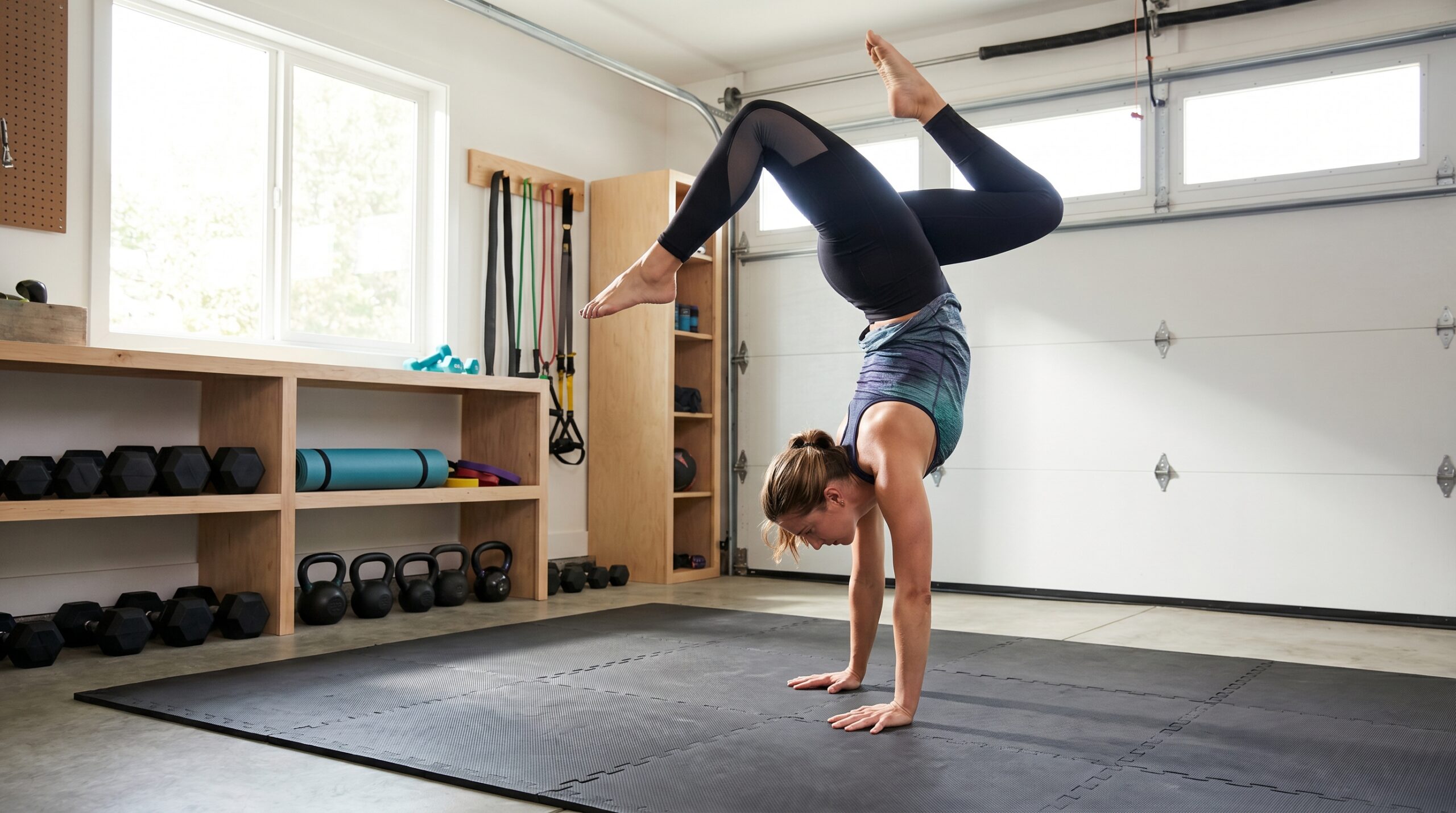
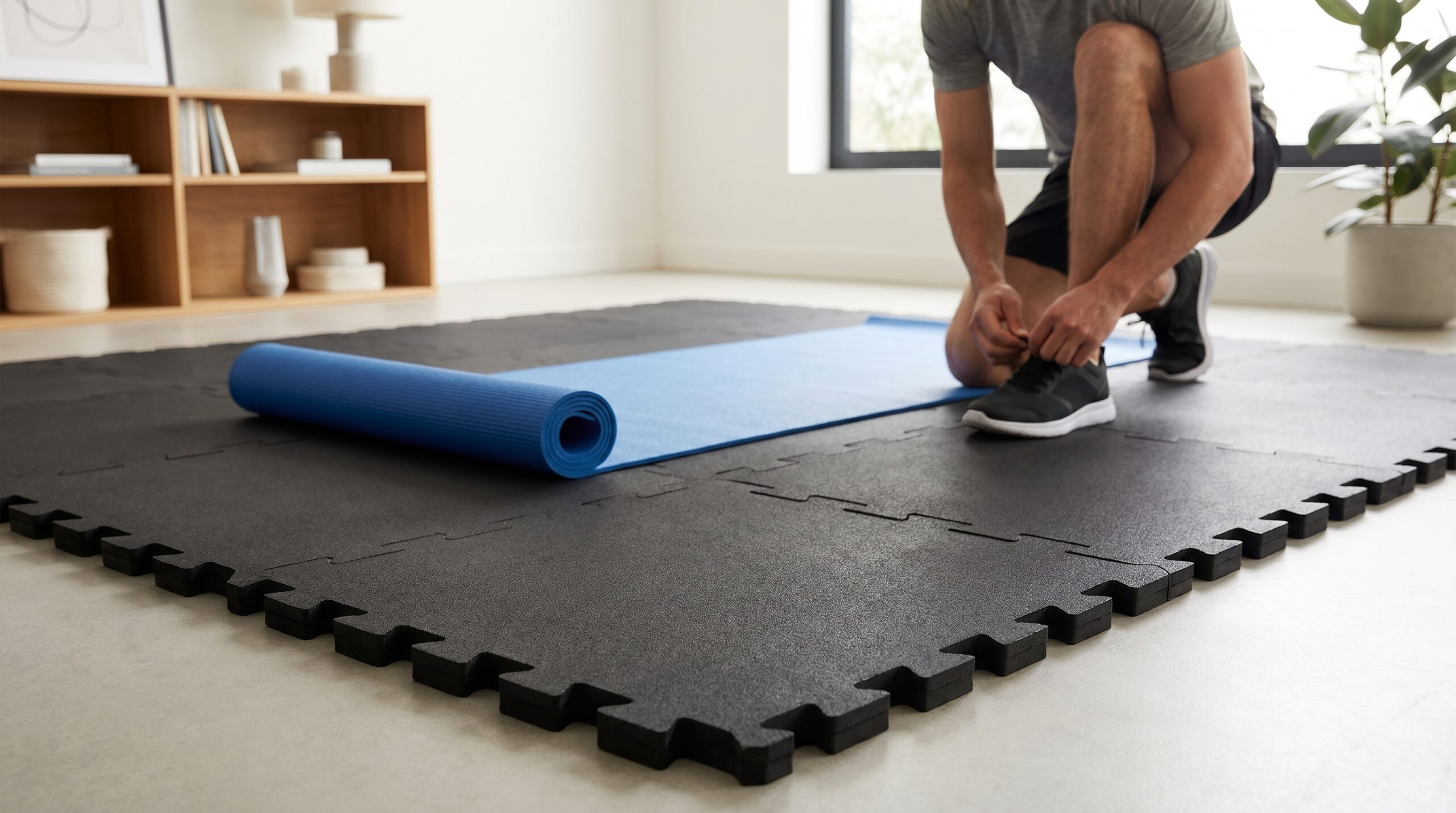
Unlike the classic gym mat, which you take out and put away, tiles generally fit together like a puzzle to create a unified, permanent floor. They offer formidable protection against impact and visually delimit your workout space. Made from high-density Eva foam or recycled rubber, they offer many advantages for floor practice:
- Acoustic absorption: if you live in an apartment or have neighbors below, the tiles considerably muffle the noise of your jumps and falls.
- Thermal insulation: practising barefoot or in socks on cold tiles is very unpleasant. Tiles insulate against the cold and make practicing much more comfortable.
- Highly modular: you can adapt the shape of your drive zone to the exact configuration of your workpiece, and easily replace a single slab if it becomes damaged.
Whether you’re working on your reverse stance or performing complex mobility exercises, the slabs ensure perfect grip and reduce the risk of slipping, so you can move around in complete safety.
Complementary accessories for progress
The mastery of one’s own body does not stop at the simple technical repetition of figures. To shine in floor gymnastics, you need to develop impressive functional strength, concrete sheathing and optimal joint flexibility. This is where the integration of intelligent accessories comes into its own to diversify your sessions.
Strengthening and crosstraining equipment
A common mistake is to think that bodyweight training is self-sufficient. If it is the basis, progress can quickly stagnate without additional load or instability. To hold demanding figures, you’ll need to target your muscle strengthening precisely.
That’s why it’s so interesting to create a synergy between traditional gymnastics and crosstraining methods. The addition of small, versatile, space-saving and economical equipment will considerably enrich your range of exercises at home:
- The ab wheel: the ultimate tool for forging a core of steel. A powerful abdominal girdle is the essential prerequisite for mastering all gymnastic strength figures.
- The medicine ball: excellent for working on explosiveness, throws, or adding difficulty to your dynamic gainage exercises.
- Parallettes (or push-up handles): even though you’re on the ground, raising your hands slightly will relieve tension on your wrists and increase your range of motion (L-sit, headstand push-ups).
By integrating these fitness tools into your program, you build the athletic foundations that will make your gymnastic movements much more fluid and controlled.
Elastics and bands for warm-up
Gymnastics is an extremely demanding discipline for muscles and tendons. It’s out of the question to start your session cold, otherwise you risk serious injury. Mobility and general physical preparation should be an important part of your training.
Resistance bands (or elastics) are real Swiss Army knives for sportsmen and women. They take up no space, cost very little and offer unique progressive tension. During your warm-up, they’ll gently activate your shoulders (dislocations with elastic), awaken your glutes and mobilize your hips. At the end of the session, they’ll help you stretch further and gain that precious suppleness you need to execute graceful figures.
What’s more, if you’re integrating major strength elements that still require too much bodyweight effort, elastics can lighten you up and act as an invisible training partner that supports you during movement.
How do you set up your home gym?
Now that you know the essential equipment, it’s time to think about the practical layout of your interior. The safety and longevity of your equipment depend on how you prepare and maintain your work area.
Calculate floor space requirements
The first step is to assess how much space you really have. Gymnastics requires amplitude, especially for rolling and balancing, wheels or jumps. It’s not just a question of having the space to lay out a mat; you also need to plan for a safe “fall zone”.
Here are a few simple rules to define your evolution space:
- For static practice (sheathing, stretching, maintaining balance), a surface area of 2 meters by 1.5 meters (i.e. a large folding mat) is generally sufficient.
- For dynamic movements (rolls, short sequences), we recommend aiming for a minimum space of 2 metres by 3 metres.
- Ceiling height should not be neglected. If you’re 1.80 m tall, make sure you have at least 2.40 m to lift your arms or do your handstand without hitting the ceiling.
- Be sure to clear the perimeter of your mat or floor tiles. Remove low tables, chairs, lampposts or any sharp objects within a radius of at least 1.5 metres from your practice area to avoid any accidents in the event of you falling off balance.
Maintenance tips for your equipment
Taking care of your sports equipment not only guarantees a longer lifespan, but also ensures essential hygiene, especially for activities where you are often in direct contact with the ground (hands, face, perspiration).
Here is the recommended method for effectively maintaining your practice surfaces:
- After each intense session, wipe your gym mat or tiles with a dry or slightly damp microfiber cloth to remove magnesia residues and surface sweat.
- Once a week, perform a deeper cleaning. Prepare a solution of warm water with a little mild soap or a few drops of white vinegar. Lightly spray the surface.
- Gently rub with a non-abrasive sponge to loosen impurities embedded in the roughness of the material.
- Rinse with a clean, damp cloth, then dry immediately with a dry towel. It’s crucial never to fold up a carpet while it’s still damp, as this can lead to the development of mould or unpleasant odours.
- Store your equipment away from direct sunlight or sources of high heat (such as a radiator) which could dry out the synthetic leather or deform the Eva foam of your tiles over time.
By following these layout and cleaning tips, your floor gymnastics equipment will be a faithful companion for many years of intensive home training.
Frequently asked questions
What equipment do I need to practice floor gymnastics?
For safe practice at home, the equipment needed for floor gymnastics is primarily composed of a suitable absorption surface. A thick gym mat (3 to 5 cm) or high-density foam floor tiles are essential to absorb shocks and protect joints. Added to this are strengthening and warming-up accessories such as elastic resistance bands, an abdominal wheel for sheathing, or small parallettes to work on balance and support while taking the strain off the wrists.
What are the elements of floor gymnastics?
Floor gymnastics combines several categories of physical and technical elements. These include acrobatic elements (such as cartwheels, round-offs, handstands and saltos), flexibility elements (splits, bridges), and strength and balance elements (handstands, planks, squares). Practice links these different elements with fluidity to develop coordination, agility and total control of the body in space.
What materials are used in gymnastics?
In clubs and competitions, gymnastics uses large apparatus such as uneven bars, rings, beam, pommel horse or vault, as well as sprung flooring. On the other hand, for home practice and everyday bodyweight training, the equipment used focuses on space-saving equipment: foldable floor mats, modular shock-absorbing coverings, elastic bands, medicine balls, ceiling-mounted suspension rings, and various foam blocks or lightweight training boards.
Discover our selection of sports equipment
Find all the equipment you need to reach your goals on GladiatorFit.ch

Other articles
Newsletter
Receive our fitness tips and exclusive offers


