


Soccer Referee Equipment Buying Guide: The Essentials
The referee is often overlooked in game analyses, and yet, without him, the game simply wouldn’t exist. As the true conductor on the field, you must make crucial decisions in a fraction of a second, under pressure from players and fans. To excel in this demanding role, talent and knowledge of the rules aren’t enough—you need the right equipment. The right soccer referee gear is your best ally for commanding respect, ensuring the match runs smoothly, and allowing you to focus solely on the game.
All too often, buying guides simply list products without explaining the importance of each detail. In this article, we’ll dive into the heart of refereeing equipment. From the famous whistle to the yellow and red cards, not to mention sideline accessories and uniforms, we’ll help you build your perfect arsenal on GladiatorFit.ch. What’s more, we’ll cover an essential—and often overlooked—aspect: your physical conditioning. Because, yes, a good referee is, above all, a well-rounded athlete.
Essential Soccer Referee Equipment
To officiate a game, your authority comes through your body language, your voice, but above all through your tools. Referees must be able to rely on equipment that is 100% reliable, regardless of weather conditions. Here are the essentials of your equipment.
The Referee's Whistle: Power and Reliability
It is the instrument of your authority, the extension of your voice. Choosing a whistle is not a decision to be taken lightly when putting together your officiating kit. Historically, there have been two main types of whistles, to which a modern option has now been added:
- Ball whistles: These traditional whistles produce a very distinctive trill. However, the cork or plastic ball can sometimes get clogged with saliva, rain, or cold, which can affect the sound during a crucial whistle blast.
- Ball-less whistles: These are now the standard for top-level soccer refereeing equipment. They work using air chambers that produce high-pitched, extremely powerful sound frequencies. The legendary Fox 40 whistle is a perfect example: it never jams and can reach over 115 decibels to cut through the noise of the crowd.
- Electronic whistles: Although less common on the main field, they are sometimes used by referees during practice or by instructors. They are activated with the push of a button, which is hygienic and convenient.
For competitions, we recommend that you always carry two whistles (one in your mouth, and a spare in your pocket or attached to a lanyard on your wrist), preferably without a ball for maximum reliability.
Yellow and Red Cards: Tools for Discipline
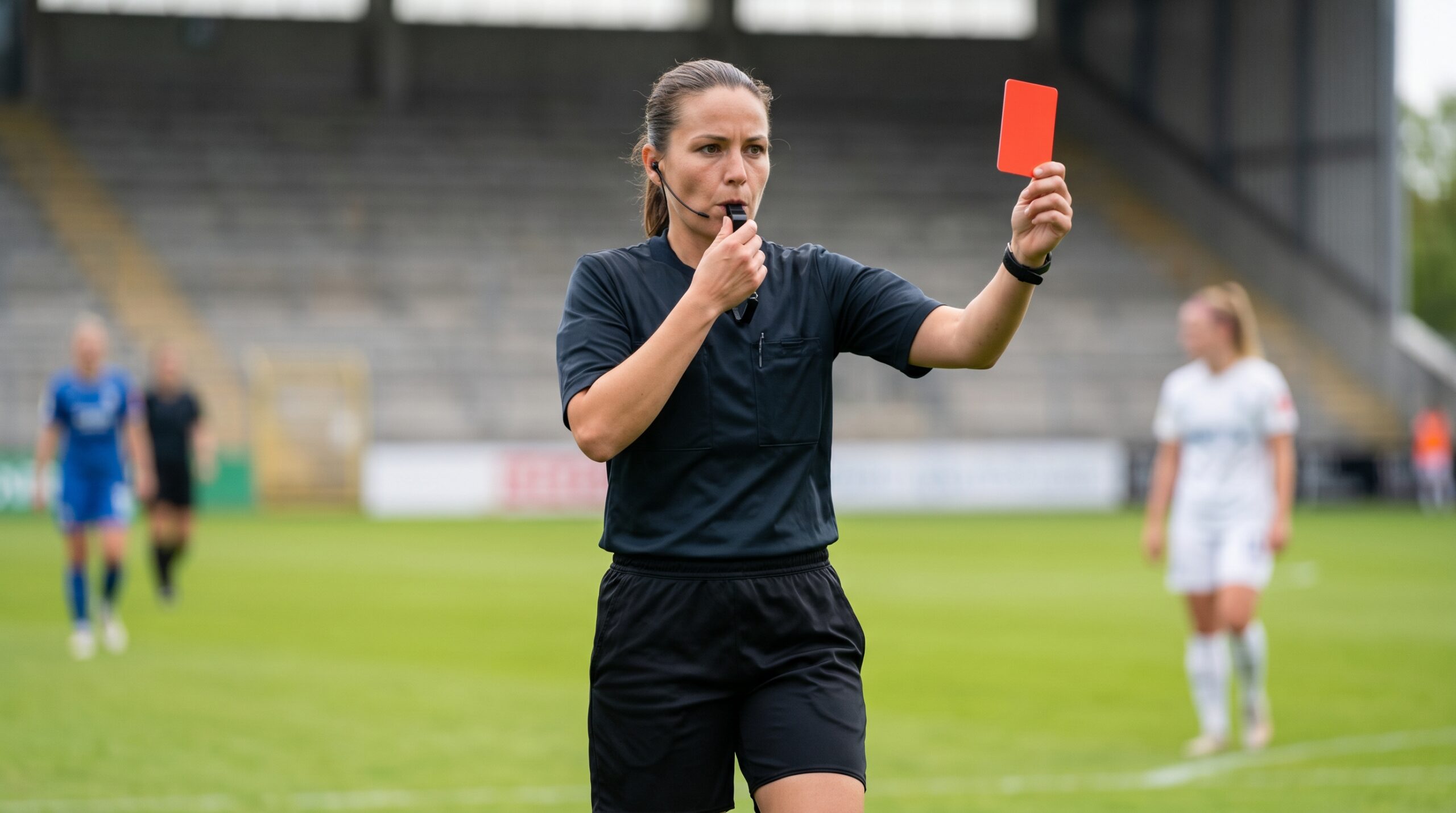
Teaching has its limits, and when words are no longer enough, cards take over. Referee cards must meet specific criteria for visibility and durability. Forget about low-quality cards that bend or tear during the first game in the rain.
You’ll need cards made of rigid PVC or weather-resistant synthetic materials. The colors must be fluorescent or extremely bright so they can be seen from a distance—by the penalized player, the crowd, and the announcer’s booth. A good card usually has a slightly rough surface on the back so you can write the number of the penalized player in pencil if you’re in a hurry, although using a notebook remains the standard practice.
Stopwatches and Watches: Mastering Game Time
Time is the only arbiter of the game besides you. A timing error can compromise the fairness of a match. A basic sports stopwatch is not enough for a modern soccer referee.
It is strongly recommended that you wear two watches. The first is used to track the official game time (45 minutes, which counts down with a vibrating alarm at the end). The second watch is used to track lost time (injuries, substitutions, celebrations) in order to calculate stoppage time. Your referee’s watch must have several essential features:
- A large dial that’s easy to read at a glance, even in the middle of a race.
- Large buttons that are easy to use, even when wearing gloves in freezing weather.
- Perfect waterproofing to withstand rain and your own sweat.
- A vibration feature, which is very useful for preventing a premature whistle from alerting the entire stadium at the end of a half.
The Official Uniform: Comfort and Authority on the Field
You can’t judge a book by its cover, but a referee’s uniform conveys authority. From the moment you step onto the field, your appearance determines the respect you’ll earn from the twenty-two players. Your uniform must be professional, comply with regulations, and be designed for athletic performance.
The referee's jersey and its special pockets
The official referee jersey is not just a regular sports T-shirt. Its colors are governed by regulations to ensure it stands out clearly from the competing teams and the goalkeeper. Black remains the traditional and imposing color, but fluorescent yellow, red, light blue, and green are now standard to avoid any visual confusion.
The detail that makes all the difference on a referee’s jersey is its chest pockets. They’re strategically designed with hook-and-loop (Velcro) closures. This security feature is vital: when you’re sprinting to keep up with a lightning-fast counterattack, you can’t have your cards or pen falling out of your pocket. Always opt for highly breathable fabrics with sweat-wicking technology, since the effort is constant.
Regulation shorts and socks
The bottom half of your uniform must meet the same comfort requirements. Official referee shorts are typically black, loose-fitting to allow for complete freedom of movement, and feature secure back and side pockets, providing additional storage space. Black soccer socks, often featuring a white stripe, complete the uniform. They should provide good support around the calves and ankles to prevent blisters during your frequent changes of direction.
Additional accessories for the officiating crew
If you have a whistle and cards, you’re ready to referee a neighborhood game. But to officiate official matches properly, there’s a whole range of small pieces of equipment that will round out your soccer refereeing gear.
Linesman's flags for assistant referees
Soccer is a team sport, and so is refereeing. The linesman (or assistant referee) plays a crucial role in signaling offsides and fouls that occur outside the referee’s field of vision. The linesman’s flag must therefore be a precise tool.
Choose flags with highly visible checkered patterns (often fluorescent yellow and orange). The pole is crucial: it must be equipped with a rotating or pivoting mechanism. This prevents the fabric from wrapping around the pole in the wind or during the natural swinging motion of the race. At higher levels, electronic flagging systems (which send a radio signal that causes the head referee’s armband or watch to vibrate) are becoming standard.
Tactical Notebooks and Referee Kits
Your pockets need to be organized like a military operation. That’s why the referee pouch is a must-have. This compact pouch lets you neatly store your referee notebook, your cards, and a small pencil or pen. The tactical notebook, with its pre-printed score sheets, lets you quickly record goal scorers, substitutions, and players who’ve received cautions—along with the exact minute the action occurred. Keeping these official soccer accessories neatly organized prevents you from having to frantically rummage through your pockets in front of impatient players.
Coins for the coin toss at kickoff
The toss coin (or commitment token) is used during the pre-game ceremony with the captains. Finis the days of using a simple, worn-out coin. Today, specialized tokens—often with one side in a light color and the other in a dark color, or featuring official logos—add an extra touch of professionalism to your performance.
Physical Conditioning: Training for Referees
Having the best soccer referee gear on the market won’t make you a good referee if you can’t keep up with the pace of the game. A center referee covers an average of 10 to 13 kilometers per game, alternating between walking, low-intensity running, lateral movements, backward running, and high-speed sprints. You’re an athlete, and your training should reflect these demands.
Cross-training to Improve Your Endurance on the Field
Physical training for referees has come a long way. It’s no longer enough to just go for a jog on Sunday morning. You need explosive power to react to a quick counterattack and rock-solid endurance to stay sharp in the 89th minute. That’s where cross-training comes in.
Workouts that combine bodyweight strength training with high-intensity interval training (HIIT) are ideal. Strengthening your footing, core, and leg power will allow you to stay close to the action at all times so you can best judge fouls.
Equipment for training outside of games
To get the most out of your workouts, the GladiatorFit.ch hybrid catalog is your best resource. You’ll find not only whistles, but all the equipment you need to build your physical fitness:
- Rhythm ladders and cones: Essential for working on your footwork, cross-step movements, and reaction time during unexpected changes in direction dictated by the ball.
- Jump ropes: The ultimate tool for an effective warm-up, improving cardiovascular fitness, and strengthening your calves.
- Kettlebells and resistance bands: Perfect for strengthening your posterior chain and preventing common injuries among referees, such as hamstring strains.
By combining state-of-the-art officiating equipment with rigorous athletic training using the right gear, you’ll be ready to take on any game, naturally commanding respect and ensuring the fairness of your decisions.
Frequently asked questions (FAQ)
What equipment is required for a soccer referee?
The mandatory and essential equipment for a soccer referee includes: at least one whistle (ideally two), cards (one yellow and one red), one or two watches with a stopwatch function, a referee’s notebook with a pen or pencil, a coin for the pre-match coin toss, as well as the complete regulation uniform (official jersey with appropriate pockets, shorts, and socks). Assistant referees, for their part, must be equipped with brightly colored sideline flags.
How to Choose the Right Referee Whistle?
To choose the right referee whistle, you should prioritize loudness, reliability, and comfort in the mouth. It is strongly recommended to choose a ball-less whistle (such as the famous Fox 40 whistle). Unlike traditional ball-bearing models, the ball-bearing-free version cannot get stuck due to saliva, gel, or dust. Also, be sure to choose a model with a silicone mouthpiece (Cushioned Mouth Grip) for added comfort, especially if you’re used to running with the whistle clenched between your teeth.
Where can you buy a complete set of referee gear in Switzerland?
You can purchase your complete set of referee equipment directly from the Swiss e-commerce site GladiatorFit.ch. The online store offers a wide range of specialized equipment for referees, including the best whistles on the market, referee pouches and cards, sideline flags, as well as all the equipment you need for your physical training (cross-training, agility, cardio) so you can start each season in peak physical condition, with fast delivery throughout Switzerland.
Discover our selection of sports equipment
Find all the equipment you need to reach your goals on GladiatorFit.ch

Other articles




Newsletter
Receive our fitness tips and exclusive offers


