


All you need to know about kettlebells: buying guide and exercises
If you’re looking to revolutionize your fitness routine and optimize your sessions at home or in the gym, the kettlebell is undoubtedly one of the most formidable and effective accessories at your disposal. A true symbol of BRUTE strength and overall fitness, this equipment with its distinctive design has become a must-have in the world of sports.
Whether you’re a seasoned athlete or taking your first steps into the world of bodybuilding equipment, incorporating this accessory into your training will profoundly change the way you move. Unlike guided machines, it teaches you to use your body as a single unit. In this comprehensive guide, we’ll explore the world of the kettlebell in detail: from its origins to its incredible benefits, including our top tips for choosing the ideal weight and mastering the fundamental movements. Get ready to take your performance to the next level with GladiatorFit.ch!
What is a kettlebell and what are its benefits?
Before you start lifting, it’s essential to understand the tool you have in your hands. The kettlebell is simply defined as a cast-iron (or sometimes steel) weight in the shape of a cannonball, topped by a wide handle that allows it to be gripped with one or two hands. Historically originating in Russia in the 18th century, where it was known as a “girya”, it was initially used as a counterweight in agricultural markets, before becoming the tool of choice for strongmen and the military to build a steely physique.
The big difference with conventional dumbbells lies in the way the weight is distributed. On a dumbbell, the center of gravity is in the middle of the handle, directly in the palm of your hand. With a kettlebell, the center of gravity is offset, located at the heart of the ball. This simple biomechanical modification changes everything: it forces your stabilizing muscles to work constantly to control the load during ballistic movements or simple holding in a static position.
An indispensable tool for crosstraining
Today, the kettlebell is at the heart of functional training. Whether for high-intensity sessions, general fitness or targeted strengthening, it adapts to all methodologies. Son’s success in crosstraining gyms is no accident: it simultaneously develops strength, cardiovascular endurance, explosive power, mobility and coordination.
Thanks to its compact shape and unique grip, it lets you link up fluid movements without having to rest the load on the floor. You can easily switch between pulling and pushing, promoting intense metabolic work that burns maximum calories in minimum time.
Which muscles does the kettlebell work?
One of the major advantages of the kettlebell is that it stimulates the whole body, eliminating the concept of “arm day” or “leg day” in favor of overall muscle strengthening. Here are the main areas stimulated:
- The posterior chain: the glutes, hamstrings and spinal erector muscles are put to great use, especially during ballistic movements requiring strong hip extension.
- The abdominal girdle: sheathing is permanent. To stabilize the off-center weight, your deep abdominals and obliques must remain contracted from the beginning to the end of the session.
- Shoulders and back: The shoulder girdle, trapezius and dorsal muscles work intensely to control the trajectory of the cast-iron ball and prevent injury.
- Forearms and grip: Holding the ergonomic grip firmly during long series develops exceptional grip strength.
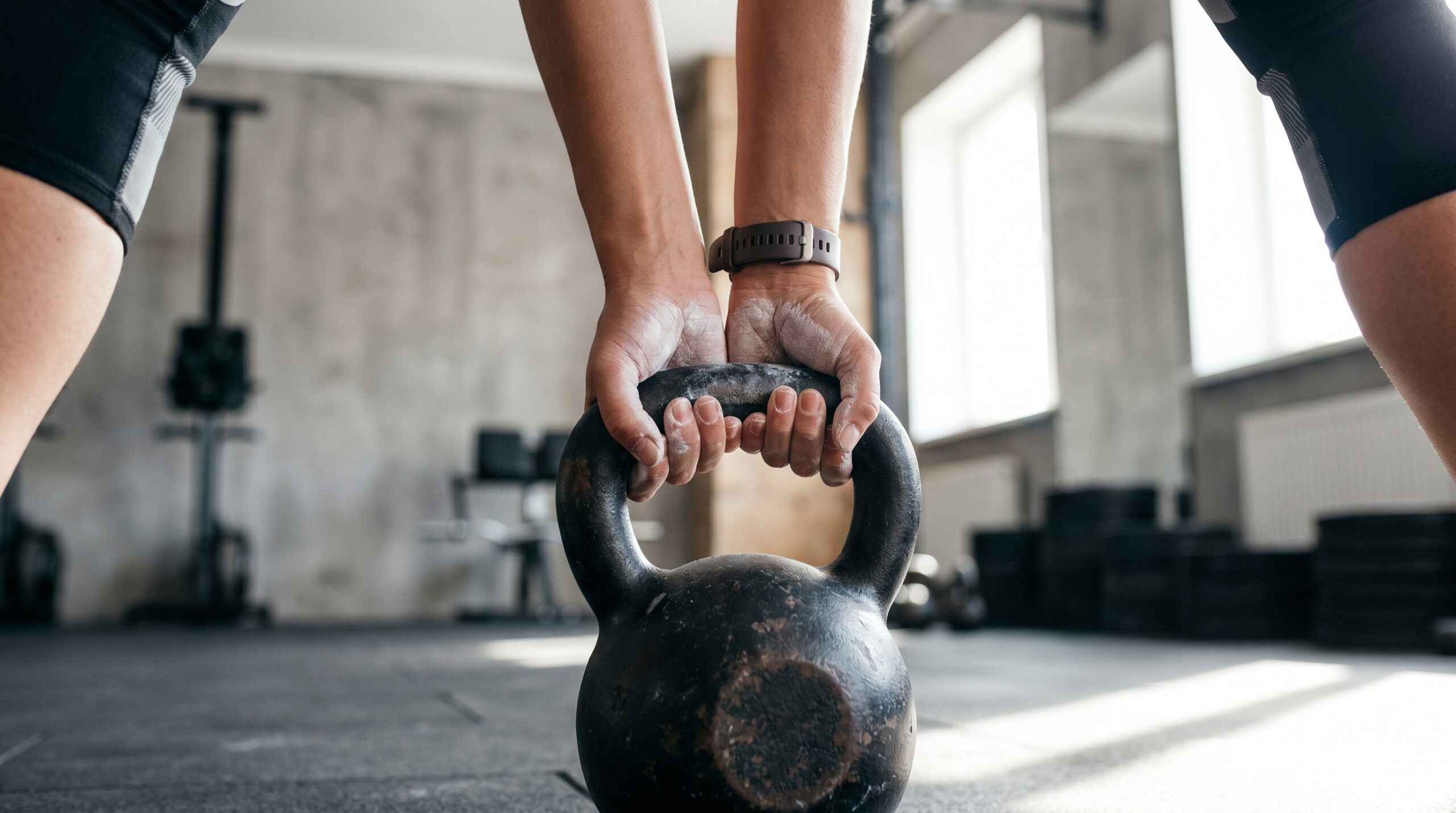
How do you choose the right weight for your kettlebell?
One of the most common mistakes is choosing the wrong weight. Too light, and you risk compensating with the strength of your arms instead of using the power of your hips, which distorts the mechanics of the exercises. Too heavy, and you compromise your technique and considerably increase the risk of injury. Here’s how to select the right equipment on GladiatorFit.ch.
What weight for beginners?
To learn basic movements safely, it’s crucial to have enough weight to “feel” the load and force the body to engage correctly.
- For women starting out: A weight between 8 kg and 12 kg is generally recommended. The 8 kg is excellent for learning strict overhead movements, while the 12 kg will be ideal for beginning swinging movements on the lower body.
- For male beginners: The standard recommendation is between 12 kg and 16 kg. 16 kg (often called “un pood” in traditional Russian jargon) is the world standard for starting to build serious functional strength.
For intermediate and advanced practitioners
Once you’ve mastered the technique, your body adapts quickly, and you’ll need to increase the load to continue improving your muscle strength and explosiveness.
- For intermediate/advanced women: The natural evolution is towards 16 kg, then 20 kg and up to 24 kg for the strongest athletes, particularly on deadlift or heavy balance movements.
- For intermediate/advanced men: The transition to 20 kg and then 24 kg marks an important milestone. Very experienced practitioners train with weights ranging from 28 kg to 32 kg, and sometimes beyond for absolute strength cycles.
Classic or competition cast-iron kettlebell?
As you browse through our catalog, you’ll notice two main product families. It’s essential to make the right choice according to your objectives:
- The classic cast-iron kettlebell: Its size increases proportionally with its weight. It has a paint or textured coating. It’s the most versatile choice for crosstraining, home fitness and general physical preparation. Its handle is often wider, making it comfortable to grip with both hands.
- The competition kettlebell (steel): Whatever its load (from 8 kg to 32 kg), its dimensions (ball size and handle thickness) remain strictly identical. They can be identified by their color code (pink for 8 kg, yellow for 16 kg, green for 24 kg, etc.). They are designed for one-handed training and specific sports practice (Girevoy sport), as the contact zone on the forearm remains unchanged, facilitating technical optimization.
Basic movements for kettlebell training
Now that you’ve chosen your equipment, it’s time to get practical. Functional training with this accessory is based on a few fundamental movements. Strict execution is the key to your results and safety.
The kettlebell swing: the king of exercises
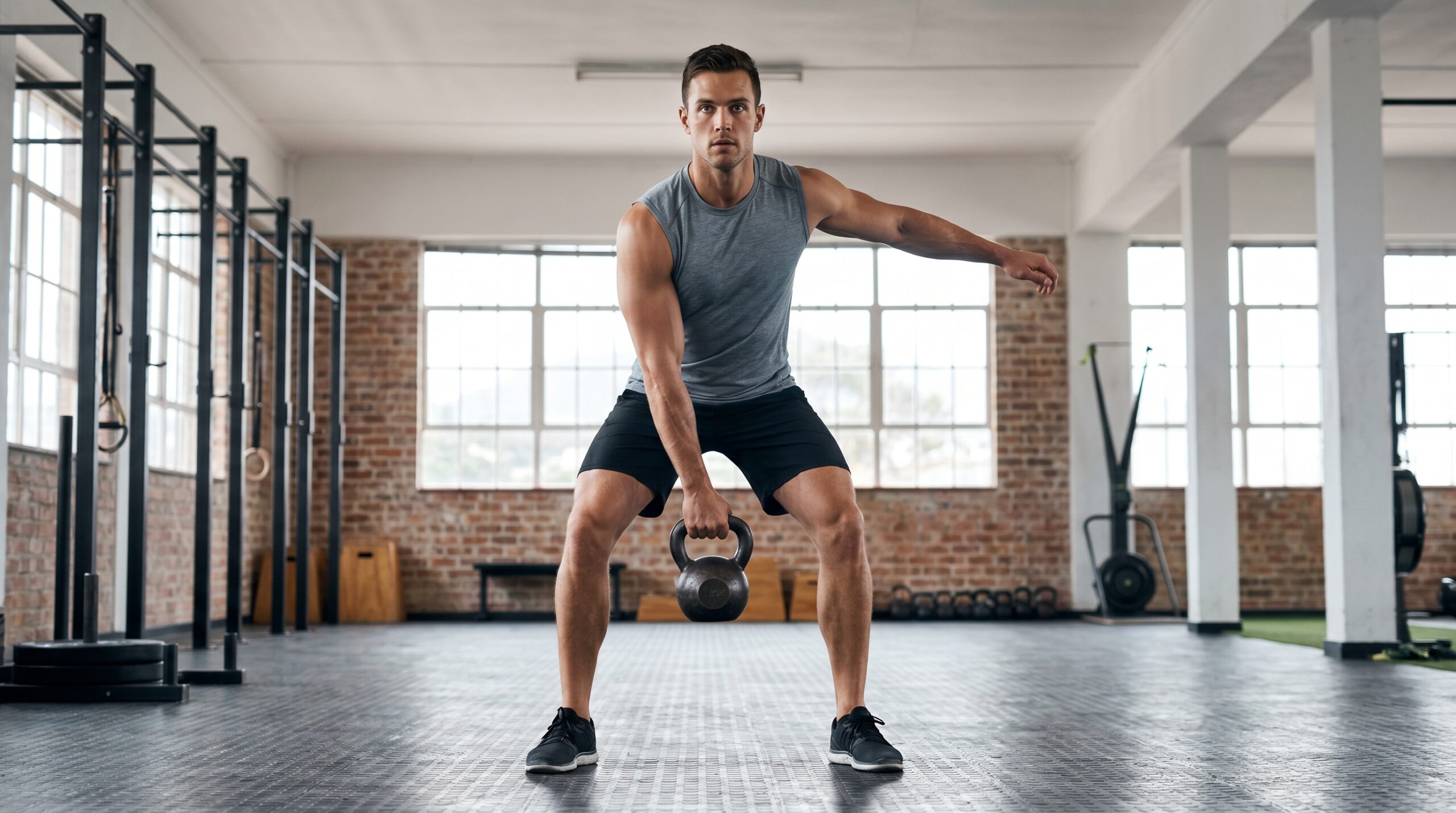
This is the ballistic movement par excellence. The swing is not a frontal elevation with the shoulders, but an explosive movement of the hips (hip hinge). It intensely targets the posterior chain and the cardiovascular system.
- Stand with your feet slightly wider than shoulder-width apart. The weight is placed on the floor, about 30 cm in front of you.
- Push your hips back, keep your back straight and bend your knees slightly. Grasp the ergonomic handle with both hands.
- Tilt the weight towards you to engage your back. Pull it dynamically between your legs, high under the crotch.
- Contract your buttocks violently and push your feet into the ground to straighten up. The energy generated by your hips will propel the ball forward.
- Let the weight rise to chest height (Russian swing) thanks to the momentum, your arms acting only as “ropes” to hold the load. Don’t pull with your shoulders.
- Let gravity bring the weight back, dodge it at the last moment by sending your hips backwards, and repeat the movement.
The goblet squat for the lower body
An excellent exercise for mastering the mechanics of the squat, the goblet squat strengthens the quadriceps and glutes, and places a heavy load on the front of the body.
- Grasp the kettlebell by the “horns” (the vertical sides of the handle) or support the ball with both hands, at chest level.
- Keep your elbows close to your body and engage your abdominals to keep your torso perfectly straight.
- Spread your feet shoulder-width apart, points slightly outwards.
- Push your hips down and back, as if you were sitting in a chair, keeping your heels firmly planted on the ground.
- Lower until your thighs are at least parallel to the floor (or lower if your mobility permits). Your elbows should touch the inside of your knees.
- Push hard on your legs to return to the starting position, blowing, while keeping your chest up.
The turkish get-up for global stability
The Turkish tuck is a slow, complex and highly effective movement for shoulder stability, joint mobility and core strength.
- Lie on your back. Place the kettlebell next to your right shoulder. Turn onto your side, grasp it with both hands and bring it down onto your stomach, resting on your back.
- Press the weight towards the ceiling with your right arm. Keep your wrist straight and your gaze fixed on the ball. Bend your right knee and place your foot flat on the floor. Your left arm and left leg are extended to the floor, forming a 45-degree angle with your body.
- Push off on your right foot and roll onto your left hip and elbow. Engage your abdominals.
- Push down on your left hand to return to a seated position, with your right arm still stretched towards the ceiling, supporting the weight.
- Lift your hips off the ground (bridge) and slide your left leg back to place your left knee on the ground, below your center of gravity.
- Straighten your torso into a low lunge position. Take your left hand off the ground.
- Push up on both legs to stand. Then return to the starting position, performing exactly the same steps in reverse order, slowly and under control.
Why buy your kettlebell from GladiatorFit.ch?
Quality equipment is the sine qua non for safe and effective training. There’s everything on the market, including sand-filled plastic equipment with disastrous balancing and hand-harming seams.
The quality and robustness of our cast-iron equipment
At GladiatorFit.ch, we select our products meticulously. Our kettlebells are designed to last a lifetime. Made from a single piece of cast iron, they are not structurally fragile. Their ergonomic handle is designed to offer a perfect balance between sufficient grip (so that the weight doesn’t slip) and a surface smooth enough not to tear the skin from the hands during high-volume sets. The finish of our models also ensures excellent magnesium retention, a crucial element during your most intense crosstraining wods.
Swiss expertise to enhance your performance
When you choose GladiatorFit.ch, you choose the excellence of a Swiss e-commerce dedicated to sport. We have a complete catalog to cover all your fitness needs. Finis no more fruitless searches and empty shelves in stores: we deliver your heavy equipment straight to your door, anywhere in Switzerland, quickly and securely. Our responsive customer service team, made up of fitness and functional training enthusiasts, is always on hand to advise you on your choice of load or the layout of your home training space. Don’t wait any longer to browse our boutique and invest in your physical potential!
Frequently asked questions about the kettlebell
Which muscle does the kettlebell work?
The kettlebell involves the whole body, making it the ideal tool for overall muscle strengthening. It primarily targets the posterior chain (glutes, hamstrings, lumbar and back muscles) during swinging movements. It also strongly engages the abdominal girdle for sheathing, as well as the shoulders, arms and forearms (grip strength) to stabilize the weight.
What is the ideal weight for a kettlebell?
The ideal weight depends on your gender, your level and the exercise you’re aiming for. As a general rule, for a beginner learning ballistic movements, we recommend 8 to 12 kg for a woman, and 12 to 16 kg for a man. For regular and intermediate exercisers, women often use loads of 16 to 20 kg, while men move towards 20 to 24 kg for functional strength development.
What are the benefits of kettlebells?
The benefits are manifold: simultaneous improvements in strength, explosive power and cardiovascular endurance. Kettlebell training also promotes improved joint mobility, accelerated fat loss thanks to its high metabolic demand, and the development of healthy posture by strengthening the deep muscles of the back and hips, which is ideal for countering a sedentary lifestyle.
What's the French name for the kettlebell?
In French, the kettlebell is often referred to as a “poids à poignée” or “Russian dumbbell”. Historically, its original Russian name is “girya”. However, in the everyday language of fitness, indoor sports and physical preparation, the English term “kettlebell” is the most widely recognized and used by practitioners and professionals alike.
Discover our selection of sports equipment
Find all the equipment you need to reach your goals on GladiatorFit.ch

Other articles
Newsletter
Receive our fitness tips and exclusive offers


