


Buying guide: choosing the right adjustable kettlebell
If you’ve ever set up a home training space, you’ve undoubtedly been faced with a major dilemma: how to get enough load range without turning your living room or garage into a warehouse? The solution often lies in optimization. This is where the adjustable kettlebell comes in. A real revolution for demanding exercisers, it combines the versatility of functional training with a minimal footprint.
Buying fitness equipment is not a decision to be taken lightly, especially when it involves accessories designed to be swung at full speed. Unlike traditional dumbbells, this famous cast-iron bell imposes a particular biomechanics that demands stability, excellent grip and, above all, infallible safety. As Swiss sports equipment experts, GladiatorFit accompanies you through this comprehensive guide to understanding, choosing and mastering this indispensable tool for your future workouts.
What is an adjustable kettlebell and how does it work?
Before replacing your entire collection of accessories with a single item, it’s crucial to understand the mechanics behind its shell. The engineering of a modular load must meet a major constraint: remain perfectly solid and balanced during intense ballistic movements.
The principle of additional weights and disks
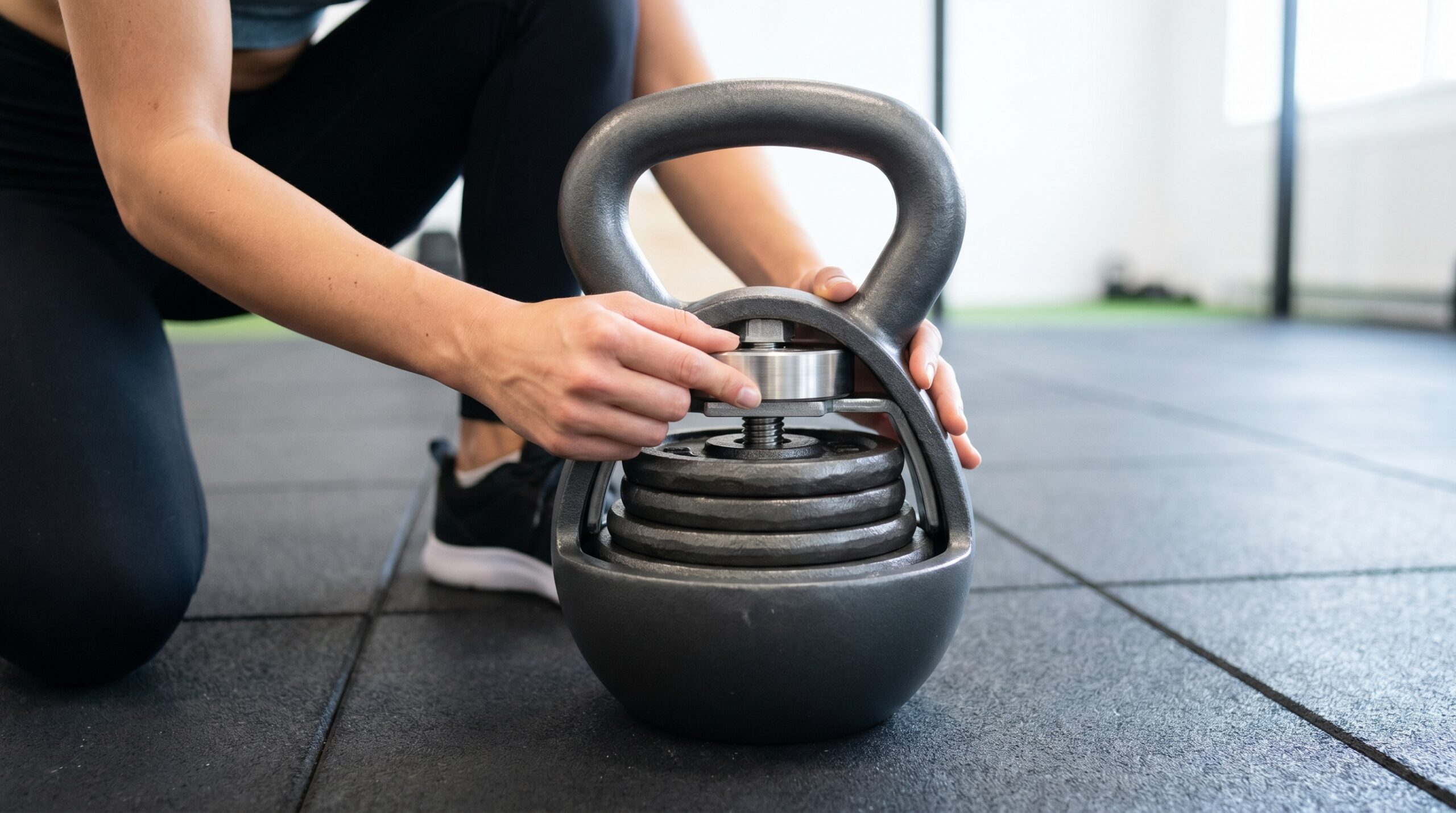
The operation of an adjustable model relies on a robust inner locking mechanism. Externally, the object resembles a classic bell. However, the lower or upper part opens (often via a screw, key or safety latch) to reveal a central axis.
It’s on this axle that you’ll be able to stack or remove cast-iron discs, specially shaped to fit together without any play. Once the disks have been inserted, a clamping nut or locking mechanism compresses the assembly. The result? No rattling, no floating inside the shell. The whole thing reacts exactly like a solid block of cast iron, keeping you safe during your dynamic movements.
Classic kettlebell vs. modular kettlebell: the match-up
One of the biggest fears of bodybuilders and functional trainers is losing the unique “feel” of the traditional Russian dumbbell with an adjustable version. It’s a legitimate concern. The center of gravity of a classic dumbbell is off-center in relation to the handle, which intensely recruits the stabilizing muscles.
High-quality adjustable models meet this challenge with flying colors. Indeed, most of them follow the design of the competition kettlebell. This means that the external dimensions (ball diameter, height, thickness and width of the handle) remain strictly identical, whether the object weighs 12 kg or 32 kg. This is a colossal biomechanical advantage: your gripping technique and forearm support remain constant with each repetition, facilitating perfect motor learning, whatever the internal load.
The benefits of the adjustable kettlebell for crosstraining
Whether you’re an experienced athlete or a beginner looking to get back into shape, integrating a modulated load into your metabolic circuits offers undeniable advantages.
Space-saving for your home gym
Space is a home trainer’s most precious resource. Lining up a full set of loads ranging from 8 to 32 kg requires a massive storage rack and floor space. The adjustable weight solves this problem instantly. A single object, around 20 centimetres in diameter, replaces a dozen fixed bells. So you can easily stow it away in a corner of the room or in a cupboard at the end of your session.
Load evolution according to your progress
In bodybuilding, the secret of success lies in progressive overload. If you buy a fixed 16 kg model, your body will eventually get used to it. To continue building muscle, you’ll need to order the next size up. With an adjustable model, you can keep pace with your progress. Adjustable increments (often from 1 to 2 kg) allow you to take realistic steps, whereas the traditional format often imposes brutal jumps of 4 kg.
A profitable long-term financial investment
It’s true that an adjustable model represents a higher initial budget than a conventional unit. However, it’s easy to do the math. Let’s add up a basic set (12, 16, 20, 24, 28 and 32 kg) plus shipping costs for heavy cast iron. The bill climbs exponentially. Buying a single modular load divides your total investment by three or four, making it the most logical and economical choice for your fitness equipment.
How to choose the right adjustable kettlebell?
Not all models on the market are created equal. To guarantee safe and efficient drives, certain technical criteria must not be compromised.
Weight range and adjustment steps
The first question to ask concerns your current strength level and your goals. Manufacturers generally offer several shells:
- Light to intermediate models: often from 8 to 18 kg, ideal for beginners, strict unilateral work or rehabilitation.
- Advanced competition models: the flagship range extends from 12 to 32 kg. This is the ultimate standard for athletes wishing to perform intense training sessions.
Also check the possible increments. The more small discs you have available, the more you’ll be able to fine-tune the load according to the day’s exercise.
Handling and safety of the mechanism
Grip is vital. Make sure the grip is the right diameter (generally 33 to 35 mm for competition format) and is neither too smooth (risk of slipping with perspiration) nor too abrasive (risk of hand tears). What’s more, the space between the handle and the body of the bell (the “window”) should allow both hands to be inserted easily for your swinging exercises.
When it comes to safety, avoid systems based on plastic clips. Opt for threaded steel pins with solid clamping nuts. Nothing should move inside when you shake the tool vigorously.
Our selection of equipment on gladiatorfit.ch
At GladiatorFit, we’ve carefully selected our equipment to meet the highest standards of crosstraining. Our modular models feature patented locking mechanisms, shock-resistant steel shells and ergonomic handles designed for repetition without unnecessary pain. You’re investing in a durable product designed for everyday performance.
The best exercises to perform with a modular load
The major advantage of your new tool is that you can instantly adapt the resistance to the chosen movement. Some exercises require a heavy load to be effective, while others require a much more measured and technical approach.
Swinging to develop explosiveness
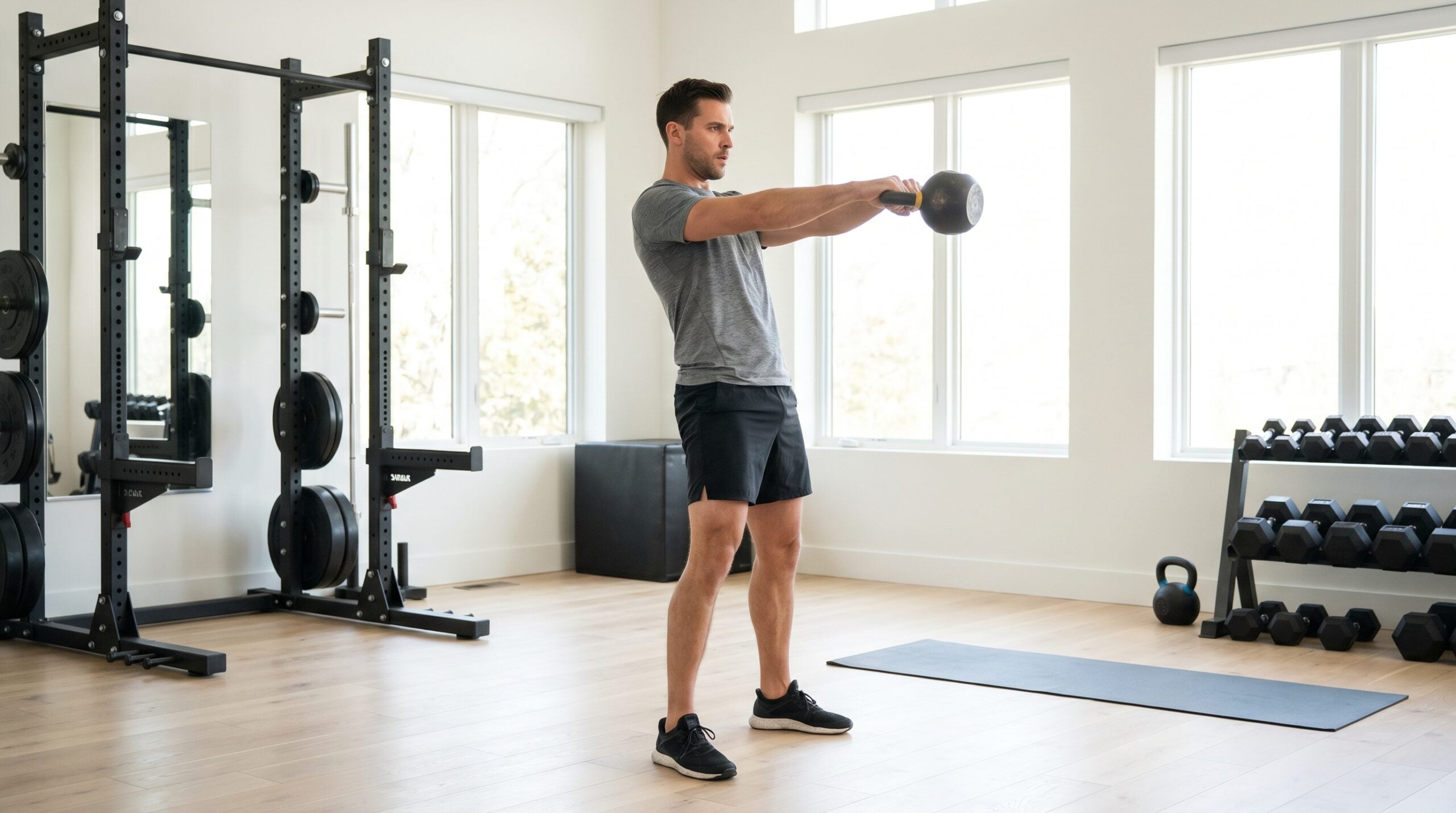
The king movement par excellence, the swing doesn’t involve lifting the arms, but propelling the weight with a violent extension of the hips. It’s a formidable ballistic exercise for the posterior chain (hamstrings, glutes, lumbar). For a perfect swing:
- Stand with your feet slightly wider than your shoulders, with the load in front of you.
- Bend your hips backwards, keeping your back neutral, to grasp the handle.
- Pull the tool briskly between your legs to create momentum (the “hike”).
- Contract your glutes violently to straighten up and propel the weight forward.
- Let the weight fall back down by gravity and accompany the movement by flexing your hips again.
Here, you’ll be using a heavy setting. If the load is too light, you’ll tend to use your shoulders to lift the bell, which totally distorts the exercise.
The goblet squat to strengthen the lower body
Ideal for working the quadriceps, glutes and deep abdominal muscles. Grasp the object by the “horns” (the sides of the handle) and hold it firmly against your chest. Lower into a squat position, keeping your torso as upright as possible, with your elbows tucked inside your knees to help open your hips. Set your equipment to a moderate-to-heavy load to get a good feel for your thigh muscles.
The turkish get-up for global stability
The Turkish tuck is a fundamental exercise for shoulder health and core strength. It involves moving from a position lying on your back to a standing position, keeping your arm stretched skywards with the weight in your hand, then lowering yourself back down. This technical movement requires absolute stability and concentration. It’s imperative to drastically reduce the load when changing exercises. This is where your adjustable model really comes into its own: in just two minutes, you go from a heavy weight used for the squat to a light, safe weight for your turkish get-up.
Frequently asked practice questions
Are adjustable kettlebells suitable?
Absolutely. They are ideal for the majority of exercisers, especially those who train at home. They are exceptionally space-saving, allow precise progressive overloading and are a highly cost-effective investment. High-quality models, with internal steel locking mechanisms, are just as safe and balanced as fixed-load models, enabling dynamic movements to be performed without the slightest risk.
What is the ideal weight for a kettlebell?
The ideal weight depends on your level, your gender and the exercise you’re aiming for. In general, women are advised to start with a weight of between 8 and 12 kg, and men between 16 and 20 kg, for basic exercises such as the swing or squat. However, for strict pressure or unilateral exercises, a lower weight will be required. That’s why you should opt for an adjustable system, which allows you to cover all these weight ranges according to your specific needs.
Which muscle does the kettlebell work?
It’s an all-round fitness tool that engages many muscle groups simultaneously. Ballistic movements primarily engage the posterior chain: hamstrings, glutes, erector spinae and trapezius muscles. What’s more, the off-center nature of the load forces the abdominal girdle and shoulder stabilizer muscles to work continuously to maintain balance, providing a very complete functional muscle workout.
What happens if I do 100 kettlebell swings a day for 30 days?
Doing this challenge every day will transform your physical condition. You’ll notice a clear improvement in your cardiovascular endurance, an increase in your grip strength and a massive development in the power of your posterior chain (glutes and hamstrings). What’s more, this intense metabolic movement is excellent for stimulating fat loss. But be sure to master the initial technique to avoid lower-back pain, and listen to your body if you feel the need for a day of active recovery.
Discover our selection of sports equipment
Find all the equipment you need to reach your goals on GladiatorFit.ch

Other articles
Newsletter
Receive our fitness tips and exclusive offers


