


Gymnastics equipment: buying guide
When we think of gymnastics equipment, our minds immediately turn to huge sports complexes, school clubs or imposing apparatus reserved for top-level athletes. However, the reality of gymnastics has evolved considerably. Today, it’s perfectly possible and even recommended to equip yourself at home with accessories that are affordable, compact and extremely versatile. Whether you’re a crosstraining enthusiast looking to perfect your movements, a fan of bodyweight work or simply want to develop your flexibility and strength from the comfort of your living room, choosing your home sports equipment is an absolutely crucial step.
Creating your own personal training space no longer requires you to break your piggy bank or sacrifice all the space in your garage. With a few well-chosen elements, you can target each muscle group, work on your balance and gain in mobility. At GladiatorFit, we’re committed to making sport accessible to everyone by offering reliable, high-performance equipment. In this comprehensive guide, we’ll take you step-by-step through a selection of must-have equipment that will transform your workout routine and turn your home into a veritable temple to self-improvement.
Essential equipment for beginning gymnastics
To get off to a good start and build a solid foundation, you don’t need to make a lot of compulsive purchases. A few key pieces are all you need to explore a multitude of exercises while guaranteeing your safety and progress. The aim is to choose durable equipment that will evolve with your level.
The gym mat: the basis for your safety
The gym mat is undoubtedly the starting point for all sports equipment. It’s not just a piece of foam on the floor, but your main ally in the fight against injury. When you’re learning tricks, rolls, handstands or simply stretching, your joints are under a great deal of stress. A good mat’s primary mission is to absorb shocks and provide you with a stable, non-slippery, comfortable surface.
For home gym practice, thickness is the number one criterion. Forget ultra-thin 4-mm yoga mats that won’t forgive falls. Go for a model at least 1 to 1.5 centimetres thick, made from high-density foam (such as NBR or TPE). These materials offer the perfect compromise: they’re soft enough to protect your knees and wrists, but firm enough to prevent you from sinking and losing your balance when leaning backwards. Don’t hesitate to browse the mats category on the GladiatorFit store to find the dimensions perfectly adapted to your morphology and your space.
Gymnastic rings for strengthening
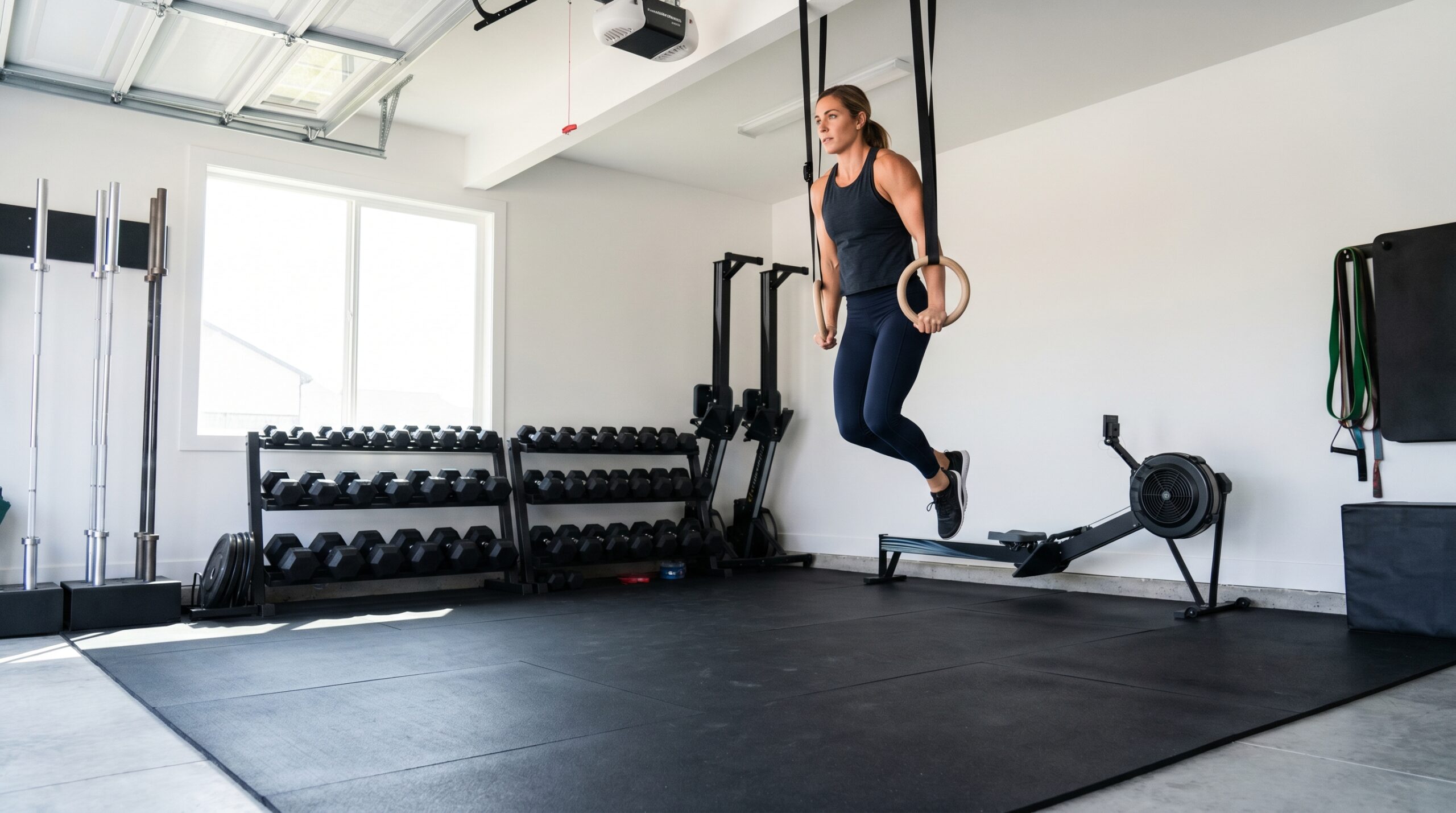
If you had to choose just one gym apparatus to radically transform your physical condition, it would undeniably be gymnastic rings. Often perceived as intimidating, they are in fact the ultimate bodyweight training tool. Unlike a traditional high bar, rings are free and unstable. This instability forces your body to constantly recruit countless deep stabilizing muscles to maintain position.
The choice of material is crucial: always opt for wooden rings. Wood offers a natural, porous texture that absorbs perspiration, guaranteeing exceptional grip even without chalk, which is highly appreciated for indoor use. Whether you’re doing pull-ups, dips, hanging sheathing or learning the famous muscle-up, the rings adapt to your level. You can easily adjust the height of the straps to modulate the difficulty of the exercises, from horizontal pull-ups (for beginners) to complex vertical movements. This is the essence of intelligent, functional muscle strengthening.
Essential gym accessories
Once the basic equipment has been installed, certain accessories make all the difference in terms of comfort, safety and efficiency. As training intensity increases, your hands and grip often become the limiting factor, even before muscle fatigue.
Magnesia for better grip
Sweat is a gymnast’s sworn enemy. Nothing is more frustrating and dangerous than feeling your hands slip off the rings or bar in the middle of a set. That’s where chalk comes in. If you’re training in a small space or in your living room, using powdered magnesia (although very effective) can quickly turn into a household nightmare because of the volatile dust.
The ideal solution for your home gym is liquid magnesia. Made from magnesium carbonate mixed with alcohol, it is applied like a cream. In just a few seconds, the alcohol evaporates, leaving a thin, ultra-adherent white layer on your palms, with no residue in the air. It guarantees a firm, secure grip, essential for heavy pulling exercises or prolonged suspension phases. It’s the affordable little addition that will instantly boost your performance and confidence during suspended movements.
Potholders to protect your hands
Regular bodyweight training and dynamic movements generate considerable friction on the palms of the hands. Without adequate protection, the horn forms, thickens and inevitably tears off, causing painful injuries that can halt your progress for days.
To overcome this problem, protective potholders are absolutely essential. They come in the form of pieces of leather or technical synthetic materials (such as carbon or Kevlar) which are placed between your skin and the apparatus. They fasten around your wrist with a Velcro strap and cover the palm of your hand. In addition to preventing blisters and tears during repeated hangs, good potholders create a slight leverage effect that relieves your forearms, allowing you to do more repetitions. It’s a small investment that guarantees regular, pain-free workouts.
Designing your home gym space
Creating a real workout space at home requires a little ingenuity, especially if you’re short on space. The key is to choose multi-purpose equipment that blends easily into your interior without detracting from it, while offering maximum exercise possibilities.
The wall espalier for flexibility and strength
Often relegated to memories of school gyms, wall-mounted espaliers are making a comeback in home sports equipment. It’s the perfect solution for optimizing a small space: fixed against a wall, it hardly encroaches on the floor surface, but offers a complete vertical plane for training. Usually made from solid wood, it even adds a warm, aesthetic touch to your space.
The espalier is an incredibly rich tool. It’s fantastic for active and passive flexibility: you can place your feet or hands at different heights for deep stretches of the back, shoulders and hamstrings. It’s also an excellent support for strength. You can hang from it to perform leg raises (abdominal strap work), attach suspension straps or even use the top rungs for strict pull-ups. It’s a real multi-purpose station in its own right.
Resistance bands for progress
Gymnastics is a demanding discipline, sometimes requiring years of practice to master certain movements. This is where elastic bands come into play, acting as invisible training partners. Unlike free weights, which offer constant resistance, elastic bands offer progressive tension, ideal for adapting to human biomechanics.
They are essential for assisting athletes with complex movements. Stuck on your first pull-ups or muscle-ups on the rings? Simply wrap an elastic band around the apparatus and slide your foot or knee over it. The elastic band will relieve you of some of your body weight at the most difficult point of the movement (at the bottom), allowing you to assimilate the technique and recruit the right muscles without frustration. Available in different tensions (recognizable by their colors), they allow you to adapt the assistance and progressively decrease it as you progress. What’s more, for those on a tight budget, they’re one of the most cost-effective investments you can make in a home gym.
Bridging the gap between gymnastics and crosstraining
For a long time, gymnastics was considered an isolated sport, practiced only in specialized clubs in preparation for apparatus competitions. Today, the boundaries have exploded. The discipline has massively infused the world of general physical preparation, becoming one of the undisputed pillars of modern crosstraining.
Bodyweight gymnastic movements
In a crosstraining program, the ability to move one’s own body in space with fluidity, strength and control is fundamental. Bodyweight gymnastic movements are integrated into almost all intensive training sessions (the so-called WODs). We’re no longer just talking about weightlifting or endurance, but absolute body mastery.
Learning to stand on your hands (handstand), walk on your hands, or perform a series of handstand push-ups (HSPU) requires specific muscle strengthening of the shoulders and abdominal girdle that only gymnastic-type work can offer. By equipping yourself at home with suitable equipment, you can target your weak points gently, away from the pressure of your gym’s stopwatch. Working on your core strength at home is the best way to shatter your personal records during high-intensity sessions.
Integrate gym accessories into your routine
For the regular exerciser, the boundary between functional bodybuilding equipment and gym equipment no longer really exists. Cleverly integrating these accessories into your weekly routine will take you a step further. For example, mastering the kipping movement requires an impeccable grip and protected hands. The combined use of liquid chalk and protective potholders will enable you to link up your “toes to bar” or dynamic pull-ups smoothly and safely.
Don’t hesitate to cross-buy to enrich your home gym. The combination of gymnastic rings, a few kettlebells for strength, a skipping rope for cardio and a good mat for mobility gives you access to an infinite number of workouts, capable of rivaling the equipment in professional gyms. That’s the GladiatorFit approach: to offer you versatile equipment that adapts to your training method, not the other way round.
Frequently asked questions about gym equipment
What equipment is used in gymnastics?
In traditional gymnastics, the equipment includes large apparatus such as uneven bars, pommel horse, beam, vault and floor trays. However, for fitness, crosstraining or home training, the equipment used focuses on more accessible equipment: wooden rings, a pull-up bar, a wall espalier, a thick floor mat for cushioning, as well as accessories such as elastic bands, potholders and chalk.
What equipment is essential for a gym?
To make up the essentials of a functional personal gym, you need to aim for versatility. Essential equipment includes: a suspension rack (high bar or adjustable gymnastic rings) for all pulling movements, a comfortable floor mat for floor work and mobility, and a set of resistance bands for warming up and assisting with difficult movements. These three elements form the ideal basis for working the whole body in complete safety.
What should you buy for a home gym?
To set up a home gym without breaking the bank or cluttering up your space, you need to opt for compact equipment. Start by buying a good gym mat (1 to 1.5 cm thick), a pair of gymnastic rings that you can hang from the ceiling or a beam, and liquid magnesia. If you have a free wall, adding a wall-mounted espalier is an excellent investment. Last but not least, you’ll need protective potholders to keep your hands safe during regular suspension training.
To round off this guide, here are direct, concise answers to the most frequently asked questions by sports enthusiasts wishing to start or improve their home landscaping.
Discover our selection of sports equipment
Find all the equipment you need to reach your goals on GladiatorFit.ch

Other articles

Newsletter
Receive our fitness tips and exclusive offers


