


How to choose the right cast-iron kettlebell: complete guide
If you’re looking to transform your physique, develop functional strength and boost your performance, the cast-iron kettlebell is the absolute tool you need to integrate into your routine today. Whether you’re an avid crosstrainer, a general fitness enthusiast or setting up your own home gym, this singular piece of bodybuilding equipment offers versatility unmatched on the fitness market. At GladiatorFit.ch, we know just how crucial choosing the right equipment is to progressing safely and achieving your goals. In this comprehensive buying guide, we’ll take a deep dive into the technical features of this essential accessory. You’ll discover why cast iron is the king of materials, how to choose the right weight for your level of practice, and which ballistic movements are best for explosive results.
Why choose a cast-iron kettlebell for your workout?
The fitness market abounds with a variety of accessories and sophisticated machines, but the famous “cannonball with handle” has stood the test of time without a single wrinkle. This unwavering success is no accident: it’s based on the intrinsic mechanical properties of the material it’s made of.
The durability and strength of cast iron
Investing in sports equipment is all about long-term reliability. Cast iron is an alloy of iron and carbon renowned the world over for its exceptional robustness. A kettlebell cast in a single piece from this BRUTE material is literally designed to survive several generations. Unlike low-end plastic or vinyl models filled with sand or cement, which inevitably end up cracking, leaking or becoming unbalanced with use, cast iron withstands impact with formidable resilience.
It stands up perfectly to the extreme demands of intensive training. You can set it down on the floor at the end of an exhausting routine, carry it in the boot of your car or use it daily during your outdoor sessions: it will always retain its perfect structural integrity. This bodybuilding equipment becomes the faithful companion of your toughest WODs (Workouts of the Day), directly inspired by traditional weightlifting methods where only real metal counts.
Optimum grip
One of the most important technical criteria when executing dynamic and ballistic movements is the quality of the grip. When you’re propelling a heavy weight through the air, you need to have total confidence in your equipment. BRUTE cast iron has a natural, porous micro-texture that prevents the tool from slipping dangerously between your fingers when sweat breaks out.
For even greater performance, today’s top models feature powder coating. This high-quality matte finish provides an absolutely perfect grip, especially when combined with the use of magnesia. Chalk adheres ideally to this powder coating, guaranteeing you maximum safety and constant friction during your long series of snatches or cleans.
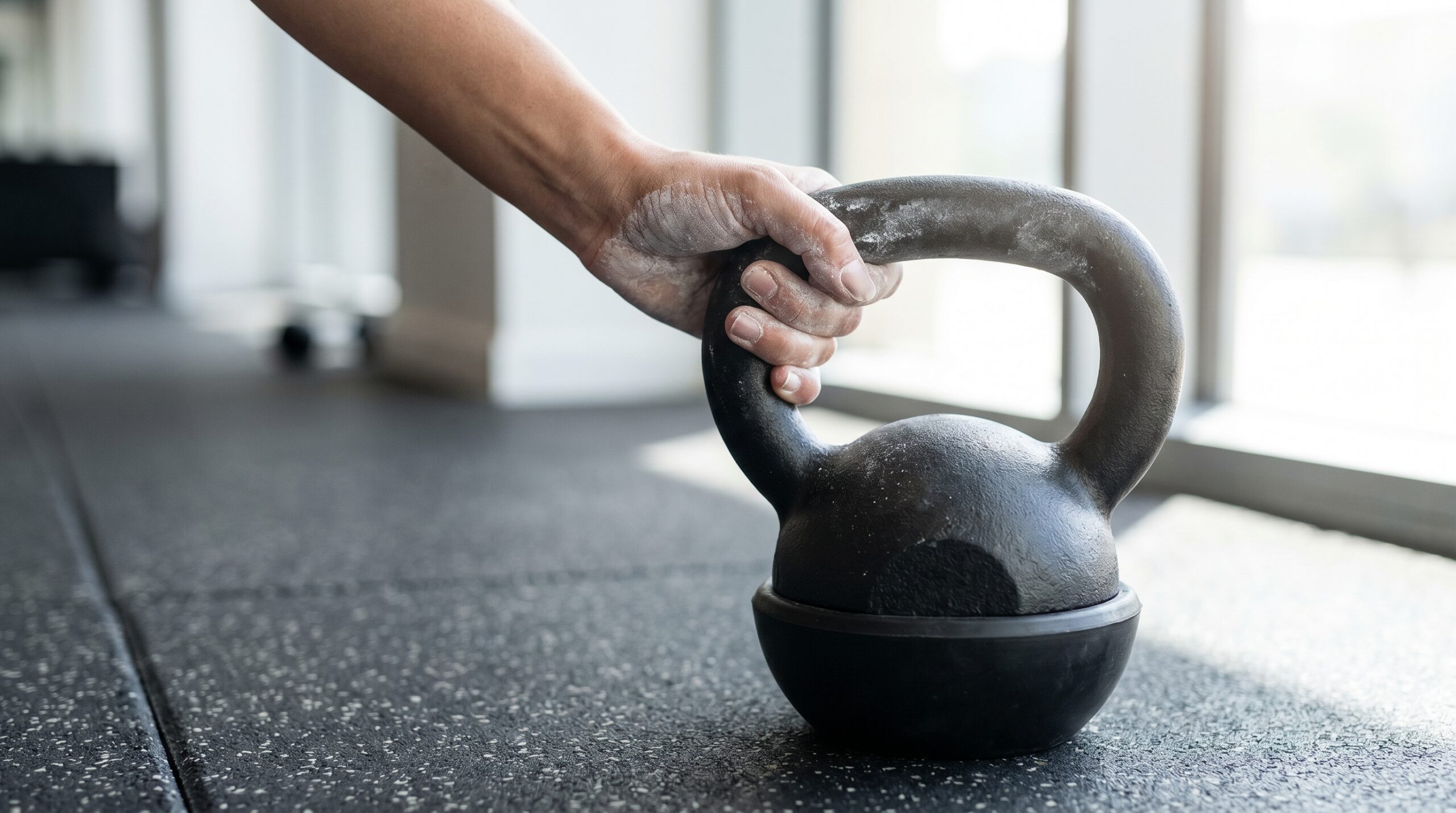
What’s more, at GladiatorFit.ch, we fully understand the constraints of practicing at home. That’s why we’ve come up with specific models cleverly equipped with a rubber base. This major innovation is a real must-have for your home gym: the protective layer effectively protects your parquet or tiled floor from accidental scratches, while considerably reducing noise pollution when you put your weight down. It’s the perfect compromise between the positive roughness of cast iron and respect for your daily training environment.
Steel or cast iron: how to make the right choice?
This is undoubtedly the classic question that every practitioner asks when it’s time to validate his or her basket. While both materials dominate the market and each has its own fervent supporters, in reality they meet very different biomechanical needs and training standards.
Advantages of the classic cast-iron kettlebell
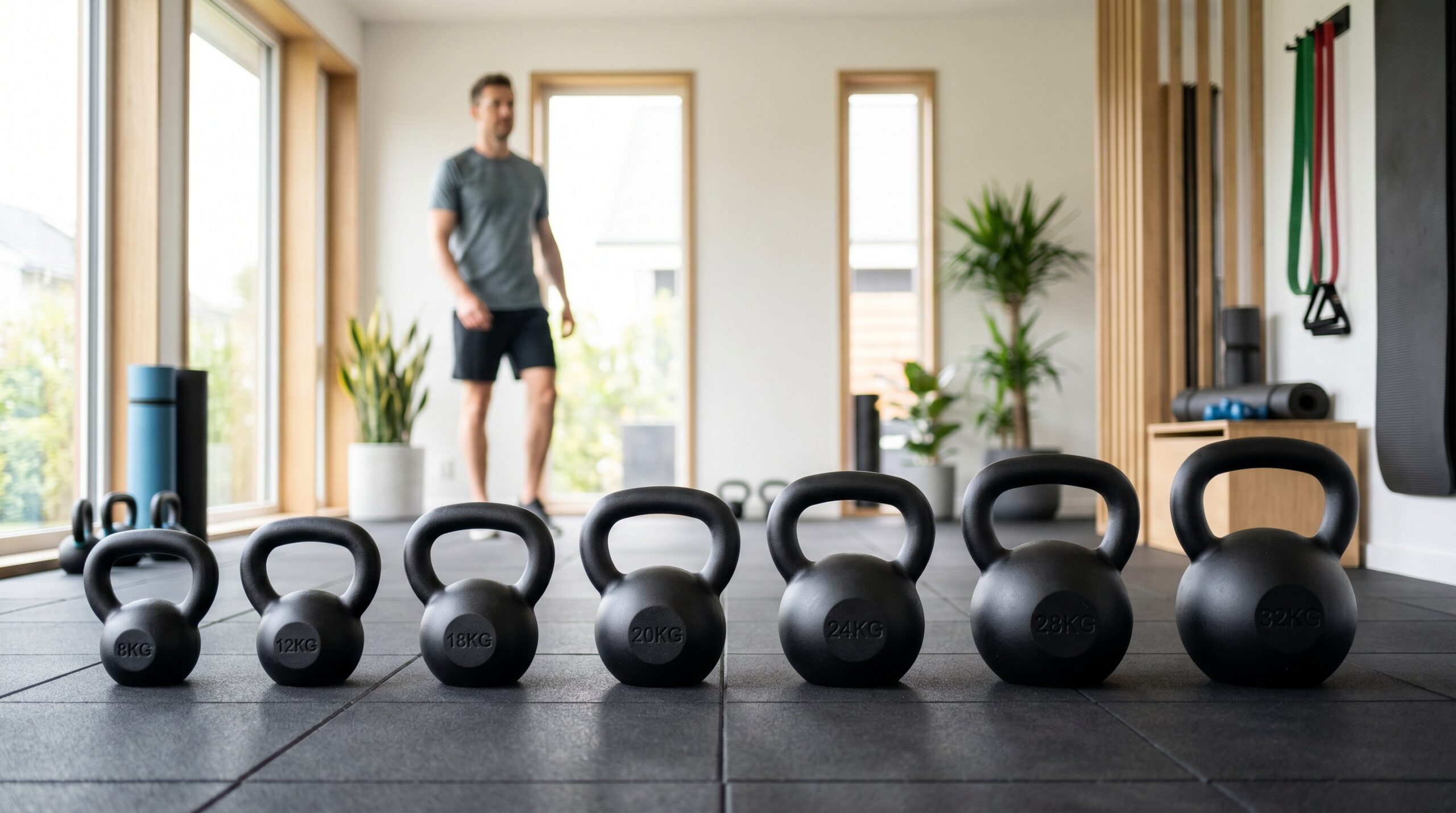
The founding characteristic of cast iron lies in its evolutionary dimensional design: the overall size of the ball increases proportionally with its weight. In concrete terms, an 8 kg kettlebell will be physically much smaller and more compact than a massive 24 kg or 32 kg model.
This technical aspect is a huge strategic advantage for crosstraining and general physical preparation. Indeed, the compactness of light weights means that novice athletes can learn movement trajectories without being hindered or unbalanced by excessive volume passing between the legs or resting on the forearms in the rack position. What’s more, the object’s center of gravity changes subtly with increasing diameter, offering an organic feel and stabilization requirement much appreciated by functional strength purists. The handle, which is often designed to be slightly wider than on competition models, greatly facilitates a comfortable two-handed grip, which is a sine qua non for learning fundamental basic exercises such as the classic swing.
Differences from steel kettlebells
In complete contrast to the logic of cast iron, the steel kettlebell (often referred to as a “competition kettlebell” or “girya” in Russia) has strictly standardized dimensions. Whether it weighs a light 8 kg or a crushing 32 kg, its height, base diameter, handle curvature and grip thickness remain millimetrically identical.
This very strict standard is imposed for official sporting competitions (the Kettlebell Sport, or Girevoy Sport) so that the hand insertion technique and the lifter’s balance are never disturbed by a change in morphological volume as he progressively increases his load over the years.
So, what should you choose for your personal use? If your long-term goal is to participate specifically in kettlebell lifting competitions, or to perform very long one-handed marathon sets for 10 minutes without putting the weight down, steel is the relevant tool. On the other hand, if your primary aim is to develop your overall fitness, burn as much fat as possible in circuit training, or gain functional athletic strength as part of an intensive crosstraining program, cast iron is undoubtedly the best strategic choice. It’s far more versatile, often more accessible in terms of initial budget, and its natural ergonomics adapt infinitely better to the vast majority of morphologies and shoulder widths.
How to choose the right weight for your cast-iron kettlebell?
Selecting the right workload is a crucial step in ensuring linear progression while avoiding overuse injuries. Unlike conventional dumbbells, which are traditionally raised in small increments of 1 or 2 kilos, the kettlebell ecosystem generally operates in historical increments of 4 kg (a standard derived from the old Russian measurement, the “pood”, which is equivalent to just over 16 kg).
Beginners: what weight to start with?
It’s extremely common for neophytes to overestimate their absolute strength or, conversely, to underestimate the dynamics of their hips. For a woman new to strength training, acquiring an 8 kg weight is an excellent starting point for serenely learning the technique of strict upper-body movements (vertical presses, back pulls) and beginning to master the hip hinge. Very quickly, a larger 12 kg model will become indispensable for effectively challenging the legs and glutes with ballistic movements.
For a beginner in good general health, the recommended starting weight is usually 12 kg, to master complex technical work and warm-up routines. The 16 kg weight will be the main workload for the heart of the metabolic session. It’s vital to understand that dynamic movements generate strong momentum and gravity. A weight that’s too light won’t allow you to feel the famous biomechanical “lock” of your hips, making learning the movement artificial and ineffective. So don’t be afraid to challenge yourself with a suitable load, while always favouring strict technical execution.
Advanced crosstrainers
If you’re already very familiar with handling free weights and your body is neurologically conditioned to intense effort, your equipment requirements change radically. Advanced athletes will generally use workloads of between 16 kg and 24 kg for women, and between 24 kg and 32 kg for men, particularly on the main exercises involving the lower limbs.
The key to continuous progress in strength and hypertrophy lies in applying the principle of stimulus variation. So, as you progress, it’s highly advisable to equip yourself with several different sizes. Having a range covering different needs enables you to structure truly comprehensive programs: light weights to work on joint mobility or specific warm-ups (such as the Turkish Get-Up), medium weights for cardio WODs, and very heavy loads to overload the central nervous system on deadlifts or heavy swings.
We invite you to browse the full range of weights available in GladiatorFit.ch’s online catalog, from 4 kg to monsters weighing 32 kg and over, to build your perfect strength arsenal with peace of mind. A smart investment in three different sizes (e.g. a 12 kg, 16 kg and 24 kg triptych) usually covers almost 90% of the physiological needs of an intermediate to advanced athlete.
What exercises can I do with a cast-iron kettlebell?
The real magic of this ancestral tool lies in its unique ability to make all muscle chains work in synergy, while pushing the cardiovascular and respiratory systems to their deepest limits. Here’s a detailed explanation of two fundamental biomechanical exercises you need to master to get the most out of your equipment.
The kettlebell swing
The swing is rightly considered the king of movements. It provides a massive, dynamic workout for the entire posterior muscular chain: hamstrings, gluteus maximus, and all the erector spinae muscles (lumbar), while strongly engaging the abdominal girdle for sheathing. It’s the perfect ballistic exercise for developing explosive athletic power and considerably increasing caloric expenditure. The cast iron’s thick, ergonomic handle comes into its own here, enabling you to firmly resist the centrifugal force generated by the load.
Here are the sequential steps for carrying it out safely and with maximum efficiency:
- Stand firmly, feet apart slightly wider than shoulder-width apart, kettlebell placed on the ground about 30 centimetres in front of your toes.
- Actively push your hips back while bending your knees slightly and keeping your back perfectly straight (this is the hip-hinge movement), then grasp the handle firmly with both hands.
- Tilt the weight slightly towards you to engage the tension in your lats, then propel it aggressively backwards, high between your legs (this step is called the “hike pass”).
- Contract your glutes violently, push hard into your heels and straighten your torso explosively to send the load flying forward to chest or eye level. Your arms should remain supple, serving only as “ropes”; it’s your hips that create 100% of the driving force.
- Let gravity do its work to bring the weight down between your legs, accompanying the descent with your hips, then move straight on to the next repetitions with rhythmic fluidity. Don’t forget to exhale sharply with each hip extension.
The goblet squat
This fundamental movement is an absolute pillar of deep lower-body muscle strengthening, and integrates with rare relevance into any high-intensity crosstraining routine. Unlike the traditional squat performed with a barbell on the nape of the neck, holding the heavy load at the front of the body mechanically forces you to keep an extremely upright torso, which greatly relieves tension on the lower back while strongly activating the muscles of the anterior trunk (deep abdominals).
Step-by-step instructions for the perfect goblet squat:
- Grip your cast-iron kettlebell firmly by the “horns” (i.e. the vertical sides of the metal handle) or hold it cupped by its rounded base, and place it in direct contact against your chest, elbows tucked in and pointed towards the ground.
- Spread your feet about shoulder-width apart, with your toes pointing slightly outwards (between 15 and 30 degrees, depending on your natural joint mobility).
- Girdle your abdominal muscles powerfully, inhale deeply through your belly, and begin your descent by pushing your hips down and back, exactly as if you were trying to sit down on an invisible chair placed behind you.
- Keep your weight firmly against your sternum throughout the movement, and descend in a controlled manner until the hollow of your hips ideally passes below the upper level of your knees (if your range of motion allows, keeping your heels on the ground).
- Push with force on all your feet (insisting on the middle and heel) to return dynamically to the initial starting position, exhaling deeply from your lungs during the concentric effort.
Frequently asked questions (faq)
Which is the best kettlebell, steel or cast iron?
The best option depends entirely on your training objectives. Cast iron is generally and widely recommended for general physical preparation, crosstraining circuits and home gym workouts, thanks to its excellent grip, legendary durability and ergonomic shape that evolves with weight. Steel, with its strictly standardized dimensions whatever the load, is a piece of equipment specifically designed and conceived for professional athletes practising competitive kettlebell sport at the highest level.
Is cast iron a good material for kettlebells?
Yes, cast iron is an absolutely exceptional material for this sports equipment. It is virtually indestructible, withstands the repeated shocks of intensive training without deforming, and offers a natural porous texture that greatly improves grip. When judiciously combined with a high-quality powder coating and sometimes complemented by a protective rubber base, cast iron represents the ultimate quality standard for all functional and dynamic bodybuilding.
Are cast-iron kettlebells heavier?
No, a kilo of cast iron weighs exactly the same as a kilo of steel (or any other material). What changes is the overall volume of the object. As cast iron is a slightly less dense alloy than pure steel, for strictly the same weight, a classic cast-iron ball may appear visually a little bulkier. The real structural difference lies in the fact that cast-iron models grow morphologically as the weight increases, which is not the case with steel competition models, which remain exactly the same size from 8 kg up to 32 kg.
Discover our selection of sports equipment
Find all the equipment you need to reach your goals on GladiatorFit.ch

Other articles
Newsletter
Receive our fitness tips and exclusive offers


