Power sleds: buying guide and exercises
If you’re looking to take your training to the next level, the power sled is undoubtedly one of the most formidable and effective pieces of equipment you can incorporate into your routine. Long reserved for top-level athletes and rugby or American soccer professionals, this equipment has conquered functional gyms and established itself as a must-have for competitions like the Hyrox. But why such a craze?
The concept is childishly simple: push or pull a heavy load over a given distance. Yet behind this primitive movement lies a war machine for building an athletic physique, burning fat and developing extraordinary functional strength. In this comprehensive guide, we’ll break down everything you need to know about this equipment. From its biomechanical advantages to how to choose the right equipment for your home gym or cubicle, and the best exercises for shattering your personal records. Get ready to transform your workouts with GladiatorFit.ch.
What is a power sled and what does it do?
An essential physical preparation tool
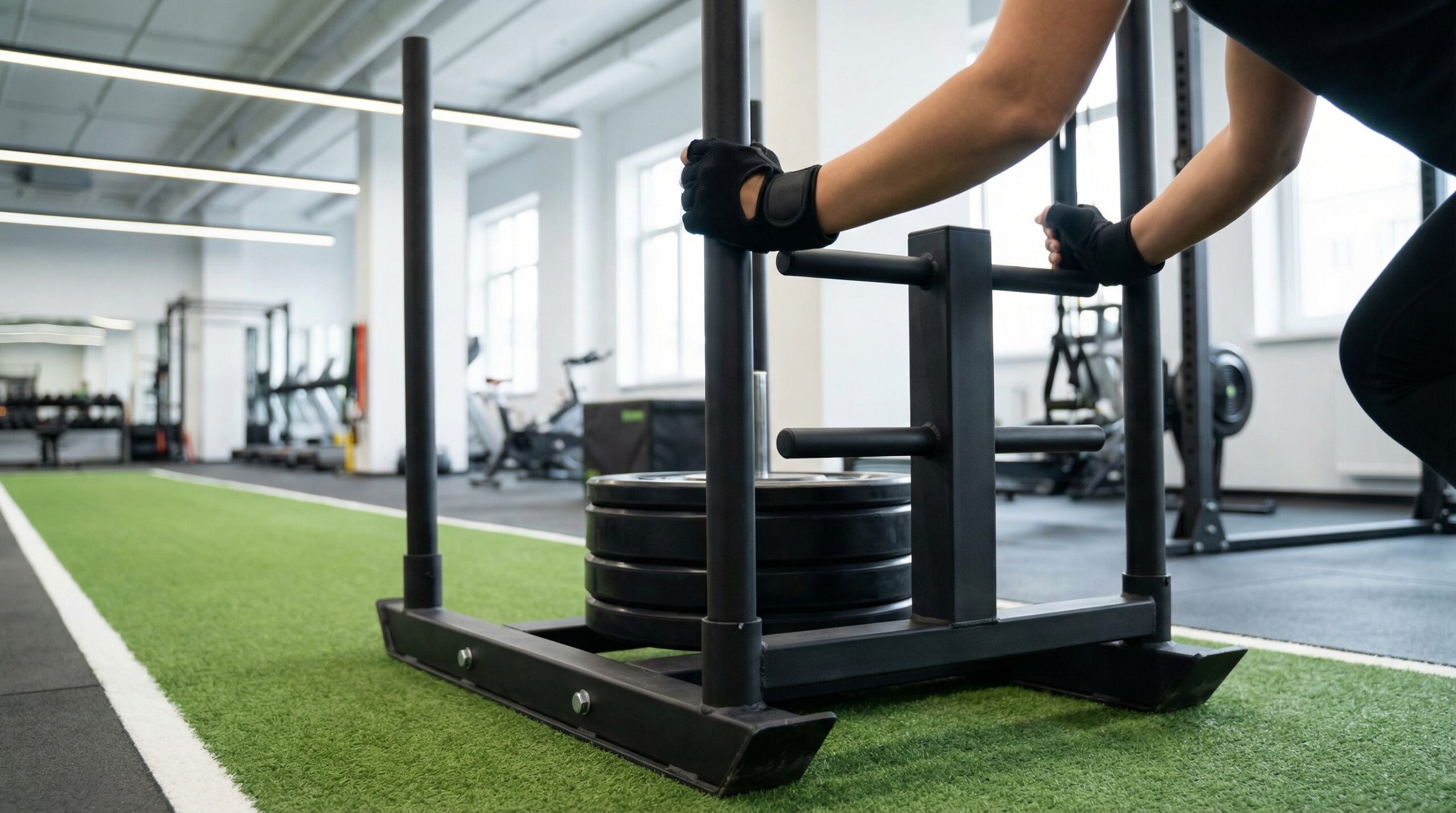
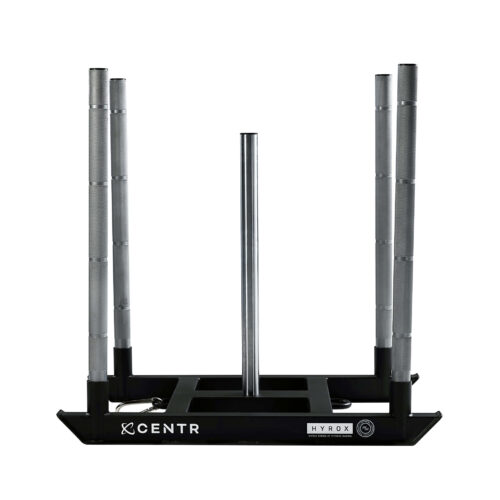
The power sled, often colloquially referred to as a bodybuilding sled, is a metal structure designed to be loaded with weights and moved by human power. Basically, this equipment consists of a sturdy steel frame, designed to withstand the most extreme loads and brutal workouts. Underneath this structure are gliding skis, whose role is to reduce friction and enable fluid movement on different surfaces.
On top, the sled is equipped with vertical rods (or finials) designed to hold Olympic discs. It’s this modularity that makes the sled an exceptional physical preparation tool: you can go from a light load for a quick sprint to a massive load for pure strength work in a matter of seconds. Whether you’re an athlete looking to improve your start on the field or a fitness enthusiast wanting to diversify your workouts, the sled adapts to your level and goals with disconcerting ease.
Benefits for crosstraining and explosiveness
It’s no coincidence that power sledding has become the star of crosstraining circuits. Son has a wide range of benefits for the body, covering almost every energy pathway. One of the major advantages of this equipment lies in the development of explosiveness. By pushing a heavy load as quickly as possible, you instantly recruit your fast-twitch muscle fibers (type II), essential for sprints and jumps.
But the real “super-power” of the bodybuilding sled lies in its unique biomechanics: there are virtually no eccentric phases. In traditional weight training (such as the squat), the eccentric phase (the downstroke) is the one that causes the most muscle micro-tears and therefore aches and pains. With the sled, all you do is push or pull (concentric phase). The result? You can train at maximum intensity, develop phenomenal lower-body strength and excellent cardiovascular endurance, all while dramatically reducing post-workout soreness and recovery time. This is an invaluable asset for athletes who need to train frequently without accumulating crippling muscle fatigue.
How to choose the right weight trainer?
Type of floor: artificial turf, indoor or outdoor
Before validating your basket, the first question to ask concerns your training environment. Your choice of equipment will intrinsically depend on the surface you’re going to use it on. The ideal surface and undisputed king for sledding is artificial turf. It offers the perfect balance between glide and resistance, while preserving your equipment.
However, if you train in a home gym on rubber tiles or outdoors on concrete, you’ll need to pay particular attention to the glide skis. At GladiatorFit.ch, we recommend models with removable and replaceable UHMW (ultra-high molecular weight polyethylene) plastic glides. These runners not only protect the metal of your sled, but more importantly, they prevent scratching or destroying the floor of your training area. If you use your sled exclusively on rough asphalt, bear in mind that the runners will wear out more quickly, and plan ahead for spare parts.
Prowler vs. pull sled
Historically, there have been two main families in this field, although the boundaries tend to blur with modern equipment:
- The prowler: recognizable by its large vertical uprights. Its design is optimized for pushing. It allows different grips (high or low) to target the posterior chain or quadriceps. It’s the king for developing BRUTE power and acceleration.
- The pull sled: Generally more compact and flat, it is designed to be attached to a strap or rope. Perfect for speed work, resistance running and upper-body exercises.
Today, to optimize your investment, the best choice remains the hybrid model. A good contemporary power sled incorporates both removable vertical uprights for pushing and sturdy anchoring rings for attaching a harness or pull rope. It’s the ultimate versatility for your training space.
Dimensions and compatibility with Olympic discs
Loading is the key to success. When choosing your weight sled, always check the diameter of the loading spike (the center or side rods). The professional standard in the fitness industry is 50 mm.
The 50 mm diameter guarantees full compatibility with your Olympic discs and bumper plates. The use of bumper plates is recommended, as their rubber coating means they won’t clatter loudly against the steel structure of your sled during intense sprints. Make sure that the height of the rod allows you to load a sufficient number of discs, as progress on this type of exercise can be lightning-fast and you’ll quickly need to add ballast.
The best exercises with a power sled
The versatility of the sled makes it ideal for full-body workouts. Here are three fundamental movements to incorporate into your routine as a matter of urgency to maximize your athletic results.
Push sprint for raw power
It’s the prowler’s signature exercise and a staple of hybrid endurance competitions. The push-up sprint is calorie-destroying and thigh-building. It reproduces the acceleration mechanics of a sprinter.
- Position yourself facing the vertical uprights and grip them firmly. You can opt for a high grip (easier on the back) or a low grip (which puts more strain on the quadriceps and glutes).
- Tilt your torso forward at an angle of about 45 degrees, keeping your spine neutral and your abdominal muscles extremely sheathed.
- Initiate the movement by pushing aggressively with the balls of your feet. The heel should barely touch the ground.
- Take powerful, rhythmic steps, as if you were trying to push the ground away from you. Don’t let your hips sway sideways.
For a crosstraining-type workout, try an EMOM (Every Minute On the Minute) format: push the heavy sled 15 meters at the start of each minute, for 10 to 15 minutes. Your metabolism will thank you.
Back pull with harness for the quadriceps
If you want your quadriceps to be made of reinforced concrete and your knees to be tough, this is the exercise for you. Popularized by rehabilitation and joint-strengthening programs (the “Knees Over Toes” method), the reverse pull-up isolates the anterior chain.
- Attach a harness to your torso or waist, and connect it to the sled with a sturdy strap.
- Turn your back to the sled and tension the cable.
- Bend your knees slightly, keep your torso upright and start walking backwards.
- Roll each step from toe to heel, forcing your quadriceps to pull the load. The muscle burn will come very quickly!
The rope pull for the upper body
Power sledding isn’t just for the lower limbs. With a simple battling rope, you can turn your sled into a formidable machine for back and arms.
- Attach a thick, long rope to the front of the sled.
- Unfold the rope to its full length and stand at the other end. You can do this exercise standing up (knees slightly bent) or sitting on the floor.
- Gird your abdominal muscles, keep your back straight, and pull the rope towards you, alternating hands as quickly as possible.
- Once the sled has reached your feet, run to the other end and do it again.
This continuous pulling movement explodes grip strength, congests the dorsal muscles and burns the biceps, all the while sending the heart rate soaring.
Why buy your equipment from GladiatorFit.ch?
Our robust and versatile sled models
At GladiatorFit.ch, we understand that bodybuilding equipment is not an expense, but a long-term investment. That’s why our sleds are made from robust, high-quality steel, epoxy powder-coated to resist corrosion, scratches and perspiration. Designed to exacting standards, our models are hybrids: they incorporate both the prowler’s push handles and the anchor points for pulling.
When you choose GladiatorFit, you’re choosing Swiss expertise. Not only do we guarantee you reliable equipment capable of withstanding hundreds of kilos, we also guarantee fast delivery straight to your door, whether you’re equipping a modest garage gym or a 500-square-meter professional crosstraining box.
Essential accessories: harnesses, ropes and bumpers
Buying a bare sled is like buying a sports car without tires. To exploit the full potential of your new equipment, we at GladiatorFit.ch offer you a complete ecosystem of accessories. Don’t forget to add a padded traction harness to your shopping basket, so you can reverse without shearing your shoulders.
Don’t forget the thick pulling rope for upper body work, and above all, the central element: bumper plates. Our Olympic disks in virgin or recycled rubber will fit perfectly on your sled. Unlike conventional cast-iron discs, bumpers absorb vibrations and protect your machine’s central spur during hard acceleration.
Frequently asked questions about the power sled
How to use a power sled?
To use a power sled, load it with Olympic discs adapted to your level. To push, place your hands on the vertical uprights, tilt your torso at 45 degrees, pack your abs and push aggressively with the front of your feet. For the pull, attach a harness or rope to the rings provided, keep your back straight and pull the load either by walking backwards, or by pulling the rope with your arms.
How much weight should I put on a sled?
The weight depends on your goal and the friction of the ground. To develop speed and explosiveness, load the sled with between 10% and 30% of your body weight so as not to alter your sprinting mechanics. To develop BRUTE strength and hypertrophy, you can load it with 1 to 2 times your body weight (even more for advanced athletes), so as to make the movement slow, continuous and extremely demanding.
Which muscles does the power sled work?
The power sled is a complete piece of equipment (full body). In push mode, it massively targets the lower body: quadriceps, glutes, hamstrings and calves, while intensely engaging the abdominal muscles to stabilize the trunk. In rope-pull mode, it strongly engages the upper body, notably the lats, trapezius, biceps and forearm muscles responsible for grip strength.
Can a power sled be used on tar?
Yes, it’s possible to use a power sled on tar or asphalt, but precautions must be taken. As tar is very abrasive, it’s imperative to equip your sled with spare hard plastic glide skis (UHMW) to avoid filing and destroying the structural steel. Bear in mind, too, that friction on tar generates a lot of noise and wears out the protective runners quickly.