


Resistance band exercise: guide and complete program
Do you still think that elastic bands are reserved for rehabilitation or light warm-ups? Think again. A well-executed resistance-band exercise can generate as much or more muscle gain than conventional dumbbells. Whether you’re a crosstrainer, a gym-goer or a home trainer, elastic bands are the most versatile tool in your arsenal.
However, not all elastic bands are created equal. Trying to do heavy squats with a tube designed for triceps, or attempting pull-ups with a mini-band, is guaranteed failure. At GladiatorFit, we know that the secret lies in combining the right movement with the right type of resistance.
In this comprehensive guide, we’ll go beyond generic lists to teach you how to structure an effective workout, choose between a training band, mini-band or tube, and transform your physique with progressive tension.
Why incorporate elastic into your training
Fitness elastic isn’t just a “practical” alternative to free weights; it offers a totally different and complementary workout mechanic to traditional cast iron. Understanding this difference is the key to maximizing your muscle development.
Benefits for muscle building
Unlike a dumbbell, where resistance is constant (dictated by gravity), the elastic band offers progressive resistance. The harder you pull, the harder it gets. This has two major advantages for your weight gain and strength:
- The right force curve: on an exercise like the biceps curl, the movement is often easy at the top with dumbbells. With a rubber band, tension is greatest at the peak of the contraction, where the muscle is shortest. This maximizes metabolic stress, a key factor in hypertrophy.
- Continuous tension: The rubber band doesn’t allow you to “cheat” with your momentum. You need to control the concentric phase (ascent) and the eccentric phase (return) to avoid being carried away by the rubber band.
- Joint preservation: Since resistance is lowest at the beginning of the movement (where joints are often most vulnerable), elastic bands are excellent for training heavy without destroying tendons. Ideal for home weight training or reathletization.
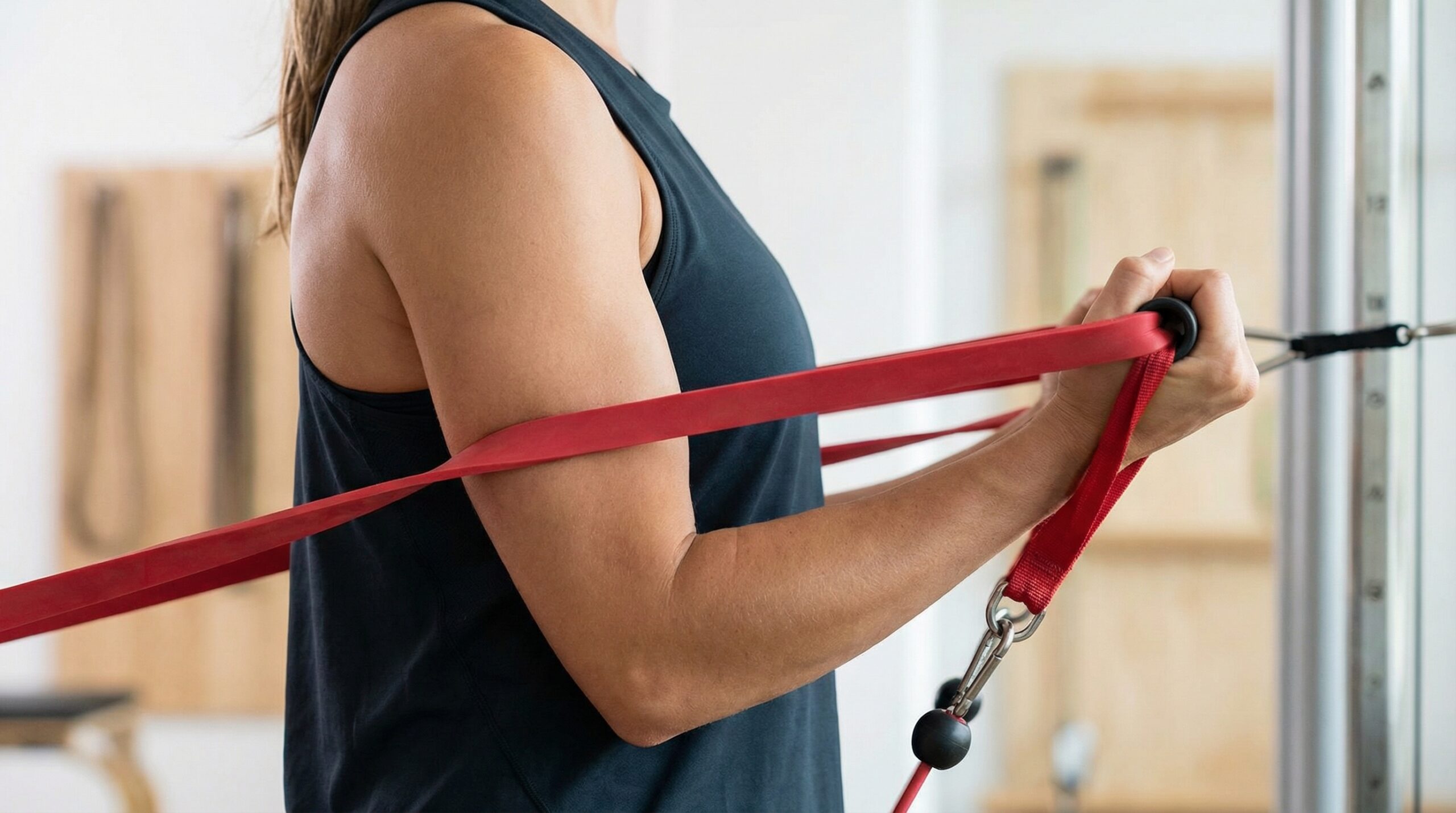
Choosing your equipment: mini-band, loop band or tube?
To succeed in your resistance band exercise, you need to use the right tool. At GladiatorFit, we distinguish three main families of essential products:
- Powerband (or Loop Band): This is a large, flat, continuous elastic band that is very robust. It comes in several colors (red, black, purple, green) corresponding to different levels of tension. It’s the king of crosstraining tools for assisted pull-ups, resistant squats or bench presses.
- Mini-band: A small elastic ring, often sold in kits of 3 or 5 intensities. Essential for activating the glutes, working the hips and improving joint mobility during warm-up.
- Resistance tube (with handles): resembles an elastic skipping rope with handles at the ends. It’s perfect for upper-body isolation work (shoulders, biceps, triceps), as the handles offer an ergonomic grip similar to that of indoor machines.
The best upper body exercises with elastic
Working the upper body with push-ups alone can quickly become limiting. The addition of elastics allows you to target the back (often neglected with bodyweight) and intensify work on the arms and pectorals.
Back and shoulders: face pull and rowing
For a thick back and healthy shoulders, pulling is essential. Here, the Powerband or resistance tube are your best allies.
Rowing (Horizontal pulling):
This exercise targets the back and rhomboids. Use a medium Powerband (black or purple).
- Attach the elastic band to a fixed point at chest height (post, door jamb).
- Grasp the elastic with both hands and step back to tension the band.
- Bend your knees slightly, keep your back straight and pull your elbows back, squeezing your shoulder blades.
- Release gently. The progressive resistance will force you to contract hard at the end of the movement.
The Face Pullover:
It’s the ultimate exercise for shoulder health and posture, targeting the back of the shoulders and the rotator cuff.
- Attach a resistance tube or light band at face level.
- Grasp the rubber band in a pronated position (palms down).
- Pull towards your face, spreading your hands so that they end on either side of your ears, as if you wanted to show off your biceps.
- Hold the contraction for a second. A must for countering the effects of office work.
Chest and arms: resistant push-ups and curls
Think push-ups are too easy? Turn them into a pure strength exercise.
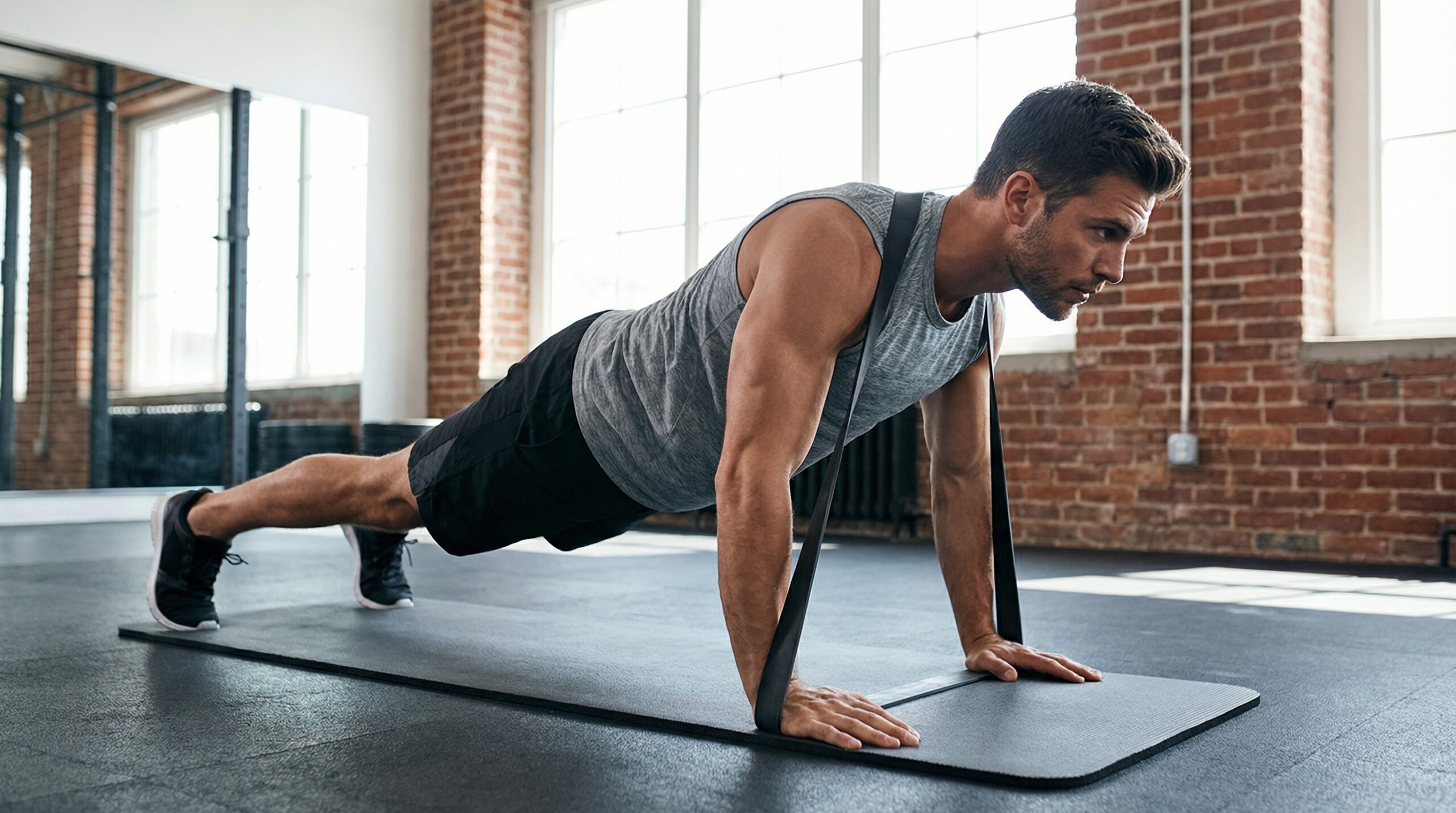
Pumps with resistance band (Resisted Push-up) :
Here, the Powerband is mandatory. Pass the band behind your back, just under your armpits, and hold the ends in your hands on the floor. In plank position, perform your pump. The elastic band will try to pin you to the ground: the pull-up will be much harder, simulating a heavy bench press. It’s a great way to explode your pecs.
Arm isolation (Biceps/Triceps) :
For the arms, choose resistance tubes with handles for comfort, or a lightweight band.
- Biceps Curl: Walk to the middle of the tube, grab the handles and flex your arms. Keep your elbows close to your ribs.
- Triceps Extension: Fix the elastic band high up. Grasp the handles, elbows to the body, and reach down with your arms. The continuous tension will burn your triceps much faster than with the pulley.
Lower body exercises for powerful legs
Never neglect “leg day”. While many believe that you can’t build big legs without a bar loaded to 100kg, the elastic band proves the opposite thanks to mechanical tension and training volume.
Squat with resistance band
The elastic squat is unsettling at first, but incredibly effective for explosiveness. It requires a sturdy Powerband (purple or green from GladiatorFit).
Technique:
- Place your feet shoulder-width apart, stepping on one of the elastic loops.
- Squat down to pass the other loop of elastic behind your neck, over your trapezius (like a barbell), supporting it with your hands so that it doesn’t slip.
- Stand up straight. You’ll feel the elastic pulling you down.
- Perform your squat. The pull-up will get harder and harder as you stretch your legs.
This exercise forces you to “push” to the end of the movement, which improves your vertical relaxation and overall power.
Lunges and buttock work
This is where the mini-band comes in. It’s the reference tool for sculpting the buttocks.
Monster Walk :
Place a mini-band of medium or heavy resistance just above your knees (or around your ankles for greater difficulty). Get into a quarter-squat position. Walk sideways, always keeping tension in the elastic (don’t let your feet touch). Your glutes will burn in seconds.
Static lunges with elastic :
Place one foot in front of the other on a Powerband. Hold the elastic band in the “front rack” position (hands on shoulders). Lower the back knee to the ground and raise. The instability created by the elastic band engages the ankle and knee stabilizing muscles enormously.
20-minute full body express program
Running out of time? Here’s a high-intensity metabolic circuit (HIIT) using only rubber bands. Perform this circuit 4 times with 1 minute 30 of rest between each lap.
The circuit sequence
- Squat with Powerband: 15 repetitions (controlled rhythm: 2 seconds down, 1 second up).
- Resistant push-ups (band in the back): 10 to 12 repetitions (If too hard, do classic push-ups and finish the series on your knees).
- Standing Rowing (Powerband attached to a pole): 15 repetitions (Focus on back contraction).
- Glute Bridge with Mini-Band: 20 repetitions. Place the mini-band over your knees and spread them outwards throughout the movement.
- Band Pull-Apart: 20 repetitions. Take a light band, arms straight out in front of you, and spread your arms so that the elastic touches your chest. Excellent for posture.
Rest time and progress
The advantage of this program is that it is infinitely adaptable. To progress :
- Decrease rest time to 1 minute, then 45 seconds.
- Increases resistance: changes from a red to a black band, or from a black to a purple band.
- Play with tempo: Slow down the eccentric phase (the return) to increase the time under tension.
Equipping yourself with a complete pack (mini-bands + 2 or 3 Powerbands of different voltages) allows you to follow this progression over several months without ever stagnating.
Faq on training with elastics
Is it possible to build muscle with resistance bands?
Yes, absolutely. Muscle hypertrophy (muscle gain) occurs when a muscle is subjected to sufficient mechanical tension and metabolic stress. Resistance bands create progressive tension that increases as the elastic stretches, intensely stressing muscle fibers. To build muscle, it’s essential to choose elastic bands with strong resistance (such as purple or green Powerbands) and to perform sets close to muscle failure.
What exercises can I do with an elastic resistance band?
The elastic band allows you to reproduce virtually all classic bodybuilding movements. You can do squats and lunges for the legs, resistance push-ups and standing press-ups for the pecs, rowing and pull-ups for the back, and bicep curls and tricep extensions for the arms. Mini-bands are specifically designed for gluteal activation exercises (monster walk, clamshell) and mobility.
How to use a resistance band safely?
For your own safety, always check the condition of the bungee cord for micro-tears before use. Make sure that the anchoring point (post, door) is extremely solid and unlikely to move. When exercising, always control the return movement (eccentric phase) to prevent the rubber band from snapping violently. Finally, choose the right resistance: a band that’s too hard can degrade your technique and cause injury.
Discover our selection of sports equipment
Find all the equipment you need to reach your goals on GladiatorFit.ch

Other articles




Newsletter
Receive our fitness tips and exclusive offers


