


Resistance bands: buying guide and must-have exercises
If you’re looking to optimize your workouts, whether at home or in the gym, the resistance band is probably the most underestimated yet effective tool on the market. Contrary to preconceived ideas that limit it to rehabilitation, today it’s a pillar of athletic performance, used by crosstrainers and bodybuilders alike. At GladiatorFit, we know that the choice of equipment makes all the difference. Here’s why and how to incorporate this versatile equipment into your routine.
Why incorporate elastic bands into your fitness routine?
Using a fitness elastic is more than just replacing a dumbbell with rubber. It’s a fundamental change in the mechanics of your movements. Here’s why you should always have one in your gym bag.
Progressive tension for strength and hypertrophy
The major difference between a dumbbell and a rubber band lies in the resistance curve. With a free weight, resistance is constant (10 kg remains 10 kg, subject to gravity). With a band, we’re talking about variable tension.
The more you stretch the band, the greater the resistance. This corresponds perfectly to the natural strength curve of your muscles on most polyarticular movements. For example, on a squat, you’re naturally stronger at the top of the movement than at the bottom. The band offers little resistance at the bottom (where you’re vulnerable) and maximum resistance at the top (where you’re strong). This balance enables optimal muscle recruitment and a different kind of nerve stimulation, essential for breaking the plateaus of progression in strength and hypertrophy.
An indispensable ally for mobility and warm-up
Before loading a heavy bar, ajoint warm-up is non-negotiable. Resistance bands activate stabilizing muscles (such as the rotator cuff for the shoulders, or the glutes for the hips) without causing excessive fatigue.
Unlike weights, which depend on vertical gravity, elastic bands allow you to apply resistance in any force vector. This means you can warm up your pushing and pulling movements horizontally, reproducing exactly the movements you’ll be performing during your workout. It’s the best way to lubricate the joints and prepare the nervous system.

The advantage of compact home gym equipment
For many of our customers in Switzerland, space is a luxury. Setting up a home gym complete with rack, bench and dumbbell set is not always possible in an apartment. The resistance band offers a complete solution for bodybuilding equipment that fits in a drawer.
What’s more, Son’s ease of transport is unrivalled. Whether you’re off for a weekend in Ticino or hiking in the Alps, you can take your gym with you. It’s the ideal tool for maintaining a full-body routine wherever you are, without having to depend on the opening hours of a gym.
The different types of bands available on GladiatorFit
In our store, you’ll find several categories of elastic bands. It’s crucial not to make a mistake, as a band designed for pull-ups will be totally unsuitable for activating the glutes.
Powerbands for crosstraining and pull-ups
These are loop bands, generally made of natural latex, which are very strong and thick. They are designed to withstand high tensions.
- Main use: Assistance with pull-ups, power exercises (powerlifting with bands), full-body stretching.
- Why choose them: If you’re looking to perform your first assisted pull-up or add difficulty to your push-ups and squats, this is the model for you.
Mini bands to activate the buttocks
Much smaller and often wider, these bands are placed around the thighs or ankles. We offer classic rubber versions, as well as the popular fabric elastic band, which doesn’t slip on the skin or pull hairs.
- Main use: Strengthening glutes, abductors, dynamic leg warm-up.
- Why choose them: Indispensable for correcting knee valgus (knees that turn inwards) when squatting.
Resistance tubes with handles for fitness
These models resemble tubular skipping ropes with snap hooks and handles at the ends. They are often supplied with a door anchor.
- Main use: Muscle insulation (biceps, triceps, shoulders), rehabilitation.
- Why choose them: They best mimic the grip of dumbbells and are more ergonomic for arm and shoulder isolation exercises.
Choosing the right level of resistance
The most common mistake is to overestimate its strength, or to misunderstand its resistance. Here’s how to decipher the technical specifications.
Understanding color coding and kg equivalents
At GladiatorFit, as in the professional world, we use a universal color code to prioritize difficulty, generally ranging from Yellow/Red (Extra Light) to Black/Gold (Extra Heavy).
But what does “30 kg resistance” mean? It doesn’t mean that the band weighs 30 kg. It means that at a certain level of stretch (often 200% or 300% of its initial length), the band exerts an opposing force equivalent to 30 kg. Note: if you only stretch it a little, the resistance may only be 5 or 10 kg.
Which voltage should you choose to start with?
It’s tempting to take the biggest band to “push heavy”, but this is often counter-productive, especially for technique. If the band is too hard, you’ll compensate with other muscles and risk injury.
- For warm-up and mobility: choose the lowest resistance (Red or Yellow).
- For pull-up assistance: Paradoxically, the more you’re a beginner, the more you need a big band (Green or Blue) to support you.
- For muscle strengthening: Medium resistance (Black or Violet) is often the best compromise for beginners.
Adapt resistance to the chosen exercise
You don’t use the same load for a squat as for a biceps curl. The same logic applies here. We strongly advise you to opt for a pack of 3 bands of different levels. This allows you to have a heavy band for legs (squat, press), a medium one for back and pecs, and a light one for shoulders and arms. Versatility is the key to harmonious muscle building.
Top 5 versatile exercises with elastic
Here’s a selection of must-do exercises to get the most out of your equipment. While we’ll cover three of the major ones here, don’t forget that elastic push-ups and the Glute Bridge complete this top 5 for a complete workout.
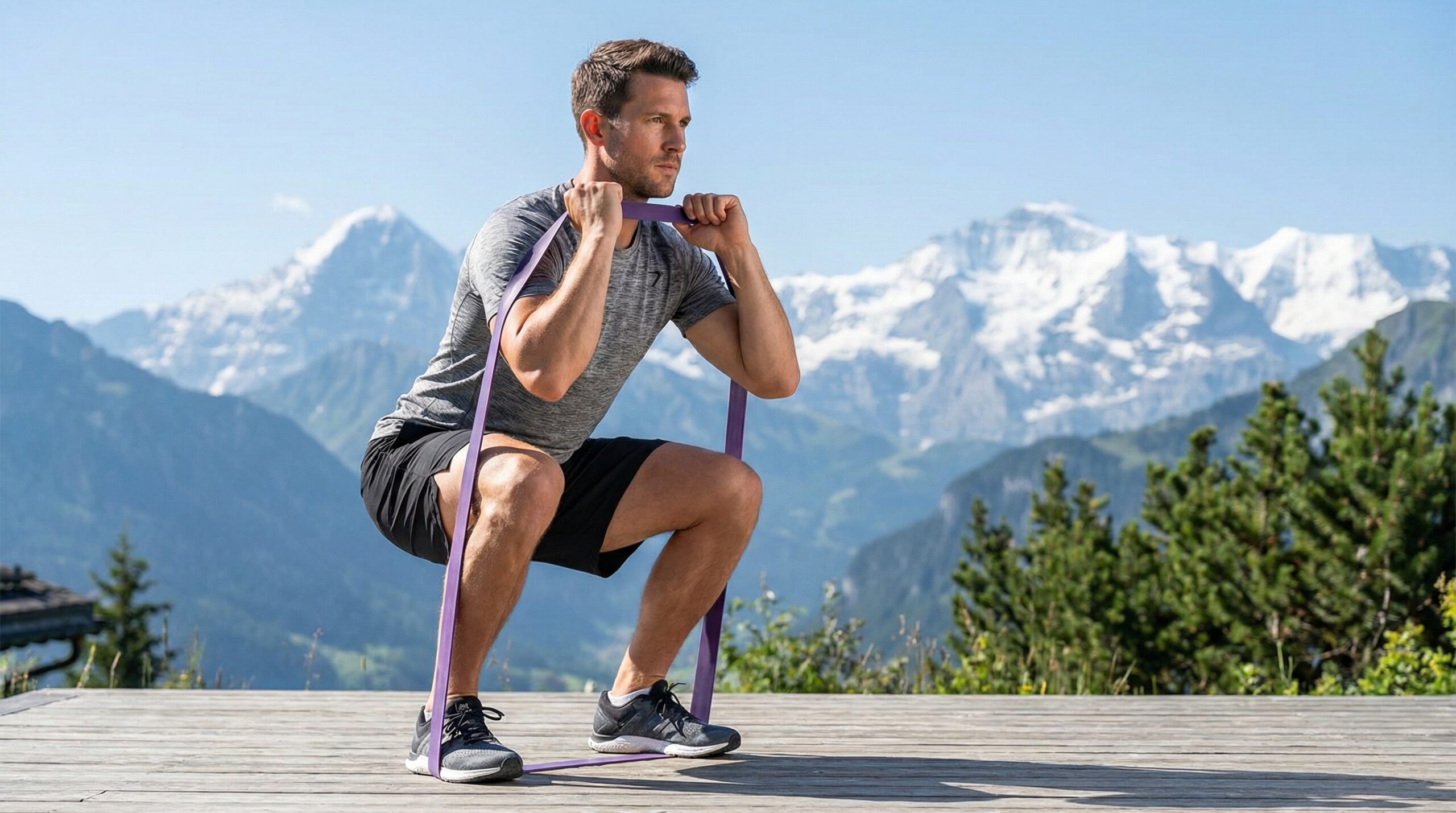
The bandaged squat to strengthen the legs
The bungee squat modifies the resistance curve to maximize tension at the top of the movement, where the quadriceps and glutes are often relaxed with a conventional barbell.
- Place your feet on the band, shoulder-width apart.
- Pass the loop on the other side behind your neck (over the trapezius, not the cervical) and straighten up.
- Lower into a squat, keeping your back straight and your heels on the ground.
- Rises explosively.
Mistake to avoid: Letting the back round out under the tension of the elastic band on the way down.
Assisted pull-ups for bodyweight progress
This is the ultimate exercise for learning to control your body weight. The elastic band acts as a “spotter” (partner), relieving you of some of your body weight.
- Tie the band to the drawbar with a lark’s head knot.
- Place a foot (or knee) in the lower loop.
- Let yourself go down, controlling the movement with your arms stretched downwards.
- Pull your chin over the bar. The elastic band will provide maximum support at the bottom of the movement to help you get started.
Mistake to avoid: Using the elastic’s momentum to bounce violently at the bottom of the movement. Keep control.
The face pull to correct posture
Ideal for countering the effects of sitting at the desk, this exercise strengthens the back of the shoulders and improves posture.
- Attach the rubber band to an anchor point at face height (post, secure door handle).
- Grasp the band with both hands, palms facing each other.
- Pull the band towards your face, spreading your elbows outwards and backwards.
- At the end of the movement, your hands should be close to your ears and your shoulder blades squeezed.
Error to avoid: Shrugging the shoulders towards the ears during the pull. Keep your shoulders low.
Faq on the use of elastic bands
What is a resistance band?
A resistance band is a latex or elastic fabric sports accessory that offers progressive resistance when stretched. It is used for muscle strengthening, mobility, assistance with bodyweight exercises (such as pull-ups) and rehabilitation. Unlike dumbbells, its resistance increases with stretching.
Are resistance bands really effective?
Yes, they are very effective for gaining strength and muscle mass. Studies show that training with elastics can produce gains similar to free weights, while reducing stress on the joints. They allow you to work continuous tension and improve explosive power thanks to variable resistance.
How to use resistance bands
You can use them in three main ways: on their own to replace weights (e.g. biceps curl), attached to a fixed point for pull-ups, or combined with free weights to modify the resistance curve (e.g. squat with bar + elastics). They can also be used to take weight off the body, for example to facilitate pull-ups.
What does a 10 kg resistance band mean?
This means that the band exerts a force equivalent to 10 kg when stretched to a certain percentage of its initial length (often between 200% and 300%). Resistance is not constant: it may be 2 kg at the start of stretching, and reach 10 kg or more at maximum extension.
Ready to take your training to the next level? Check out our full range of professional elastic bands in the GladiatorFit store and transform your workout today.
Discover our selection of sports equipment
Find all the equipment you need to reach your goals on GladiatorFit.ch

Other articles



Newsletter
Receive our fitness tips and exclusive offers


