


Swimming Equipment: A Guide to Getting the Most Out of Your Workouts
If you’re looking to optimize your overall performance, incorporating the right swimming gear into your fitness routine is a powerful strategy. Often thought of as a place just for swimmers, the pool is actually an exceptional playground for enthusiasts of bodybuilding, weightlifting, or cross-training. Water offers a unique environment that allows you to push your limits, develop exceptional endurance, and relieve stress on your nervous system after intense workouts.
Unlike traditional approaches that focus solely on glide, this GladiatorFit guide approaches swimming equipment from the perspective of athletic training. Whether you’re looking to increase your lung capacity, speed up muscle recovery after an intense squat session, or build a V-shaped back using water resistance, each accessory has a specific role. Discover how to choose the right swimming accessories to turn your laps in the pool into true functional training sessions, and how to bridge the gap between your aquatic workouts and your training with the equipment in our catalog.
Essential Gear for Beginners at the Pool
Before considering progressive resistance training in the water, it’s essential to master the basics of your swimming gear. An athlete wouldn’t go for a run in the wrong shoes; the same applies to swimming. The comfort, durability, and ergonomics of your basic gear will determine the quality of your pool training.
Choosing Your Goggles and Swim Cap
Visual comfort is often underestimated by beginners, yet it’s key to staying focused on your swimming technique and breathing. Unsuitable goggles that let in water or fog up every two laps will throw off your rhythm and turn a cardio session into a frustrating ordeal. For an optimal workout, look for swim goggles with a high-quality anti-fog coating and a wide field of vision. Hypoallergenic silicone seals ensure a perfect watertight fit without creating painful pressure around your eyes—a crucial factor when you’re stringing together long sets to build endurance.
In addition, choosing the right swim cap is crucial. Forget about fabric or thin latex caps that wear out prematurely. Investing in a silicone swim cap is essential. Thicker, it offers superior hydrodynamics by perfectly smoothing the contours of the head, thereby reducing drag in the water. Furthermore, silicone effectively protects the scalp and hair from the chemical damage caused by chlorine, while providing a secure fit even during explosive glides or somersault turns.
The Importance of a Proper Jersey for Regular Training
Durability is key for an athlete who trains regularly. Recreational or beach swimwear cannot withstand heavy use in chlorinated water. The fabric loses its elasticity, thins out, and eventually stretches out, creating unnecessary drag in the water that distorts your sense of glide and effort.
It is therefore essential to choose technical fabrics designed for performance. Look for swimsuits made from polyester blends that are highly resistant to chlorine (often labeled “chlorine resistant” or “PBT”). For men, jammers (which extend to mid-thigh) or traditional swim briefs offer excellent freedom of movement. For women, a one-piece swimsuit with an X- or O-shaped back ensures perfect support for the shoulder blades and chest, allowing for full range of motion during complex butterfly or freestyle strokes. The goal is to forget what you’re wearing so you can focus solely on engaging your muscles.
Swimming Equipment for Strength Training
Water is about eight hundred times denser than air. It is this physical property that makes it a great tool for building muscle. By adding specific equipment, you can isolate certain muscle groups and apply the same principles of progressive overload that you use at the gym.
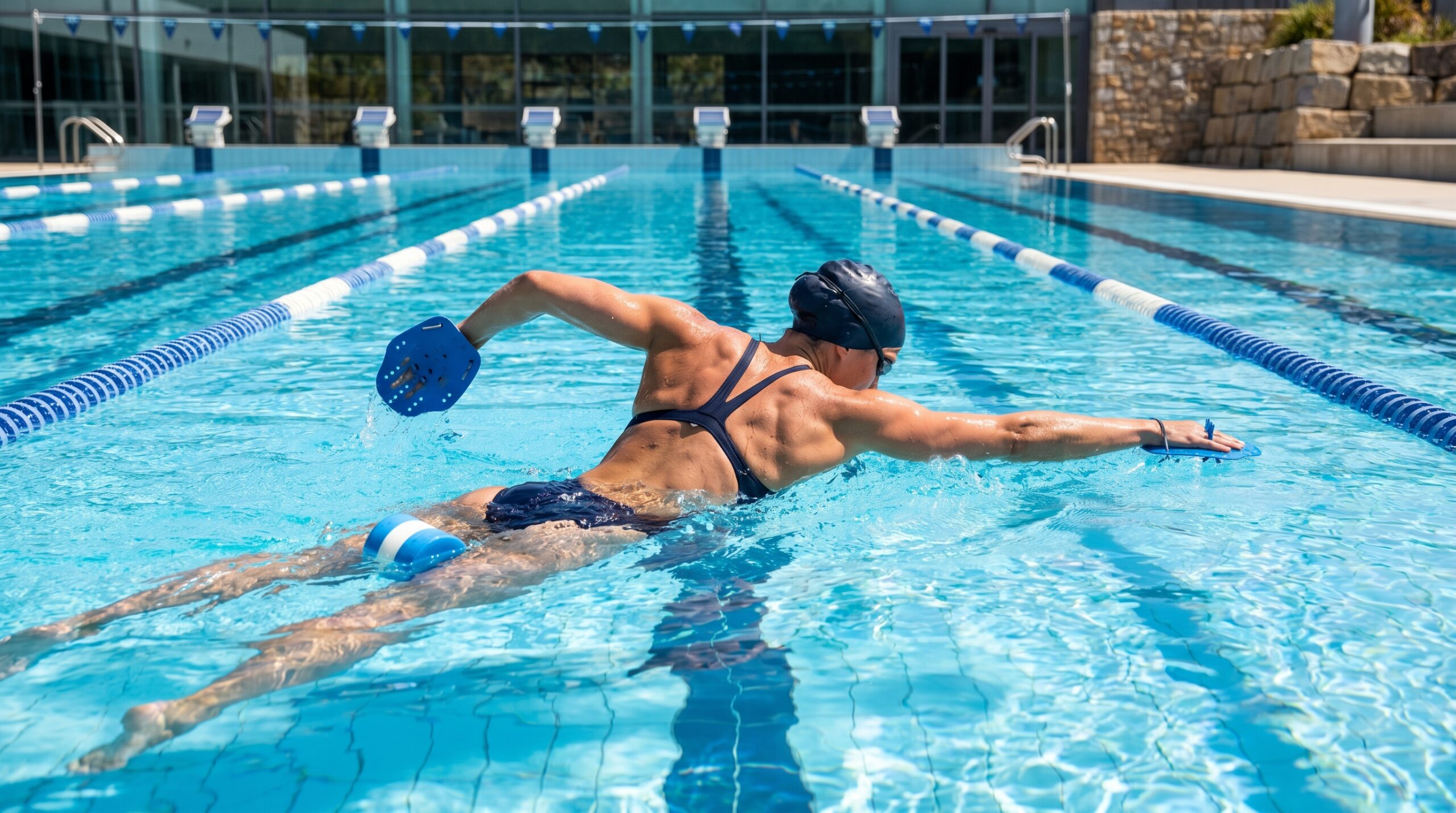
Kickboards and pull buoys for isolating muscle groups
For anyone who does strength training, isolation is a familiar technique. In the water, the pull buoy is the go-to accessory for the upper body. Placed between the thighs or ankles, this ergonomic foam block completely restricts leg movement and eliminates their contribution to propulsion. The effect is immediate: your pelvis stays aligned at the surface, and all the pulling and pushing effort is transferred to your lats, shoulders, triceps, and pecs. Swimming the crawl with a pull buoy is the equivalent of a heavy pull workout: you build pure core strength while maintaining your core stability.
Conversely, a kickboard allows you to focus exclusively on your lower body. By holding it at arm’s length or against your chest, you eliminate the use of your upper body. Kicking with a kickboard burns a massive number of calories while intensely targeting the quadriceps, hamstrings, glutes, and calves. It’s a formidable conditioning exercise that strengthens the posterior chain without any impact on the joints, making it ideal for balancing out heavy weight training.
Fins and paddles to increase endurance and power
If you want to gain explosive strength and build muscle in the water, you need to increase your surface area in contact with the water. This is where swim paddles come in. When attached to the palms of your hands, they act as additional weights. Each arm stroke requires significantly more force to overcome the water’s resistance. Swim paddles also force you to refine your technique, because a poor entry into the water will immediately result in abnormal tension in the shoulder. They’re incredibly effective for building strong shoulders and a resilient grip.
For your legs, using training fins (preferably short ones) turns your kicks into a pure power exercise. Unlike long diving fins, mini-fins require a fast kicking rhythm, which engages fast-twitch muscle fibers. They help improve ankle flexibility—a real plus for those who lack mobility in the squat—while placing extra stress on the lower abs and the psoas. The combination of kickboards and fins represents the pinnacle of strength training in the water.
Combining Swimming and Cross-Training to Improve Performance
Modern functional training is no longer limited to the walls of a box or a gym. Top athletes incorporate cross-training to break the monotony, shock the metabolism, and promote tissue regeneration. Swimming is cross-training’s most powerful ally.
Swimming as a Tool for Active Recovery
After an extremely demanding workout—such as a WOD that includes heavy deadlifts and box jumps—the body is flooded with toxins and muscle fibers are micro-torn. Complete rest is an option, but active recovery is much more effective. Doing a moderate-intensity swim the day after a hard workout promotes blood flow to the damaged muscles, thereby accelerating the elimination of lactic acid and the delivery of nutrients essential for cell repair.
The hydrostatic pressure of the water also exerts gentle pressure on the skin, acting like natural compression garments that stimulate venous return. By swimming in a smooth, relaxed manner, you’re effectively giving your entire musculoskeletal system an active massage. It’s one of the best ways to reduce muscle soreness (DOMS) and get back to 100% of your capacity faster for your next strength training session.
Build Cardio Endurance Without Straining Your Joints
Developing aerobic endurance (cardio) is essential for peak performance, but running or repeated jumping often ends up putting strain on the knees, hips, and spine. The great advantage of swimming lies in the relative weightlessness provided by the water. The body is supported, completely eliminating the microtraumas associated with impact on the ground.
So you can push your heart into high heart rate zones, do aquatic HIIT workouts (for example, 50-meter sprints with very short rest periods), or engage in long-duration basic endurance training—all without ever wearing down your joints. This approach fits perfectly with the holistic and functional training philosophy promoted by GladiatorFit: developing a high-performing, resilient athletic body—and, above all, one that lasts over time without injury.
Preparing for Your Dryland Swimming Sessions
Improving your performance in the water isn’t something that happens only in the pool. Dryland training is a method used by all elite swimmers to build sport-specific strength and correct movement biomechanics. This is where the equipment in our store really comes into its own for swimmers and triathletes.
Use resistance bands to simulate swimming
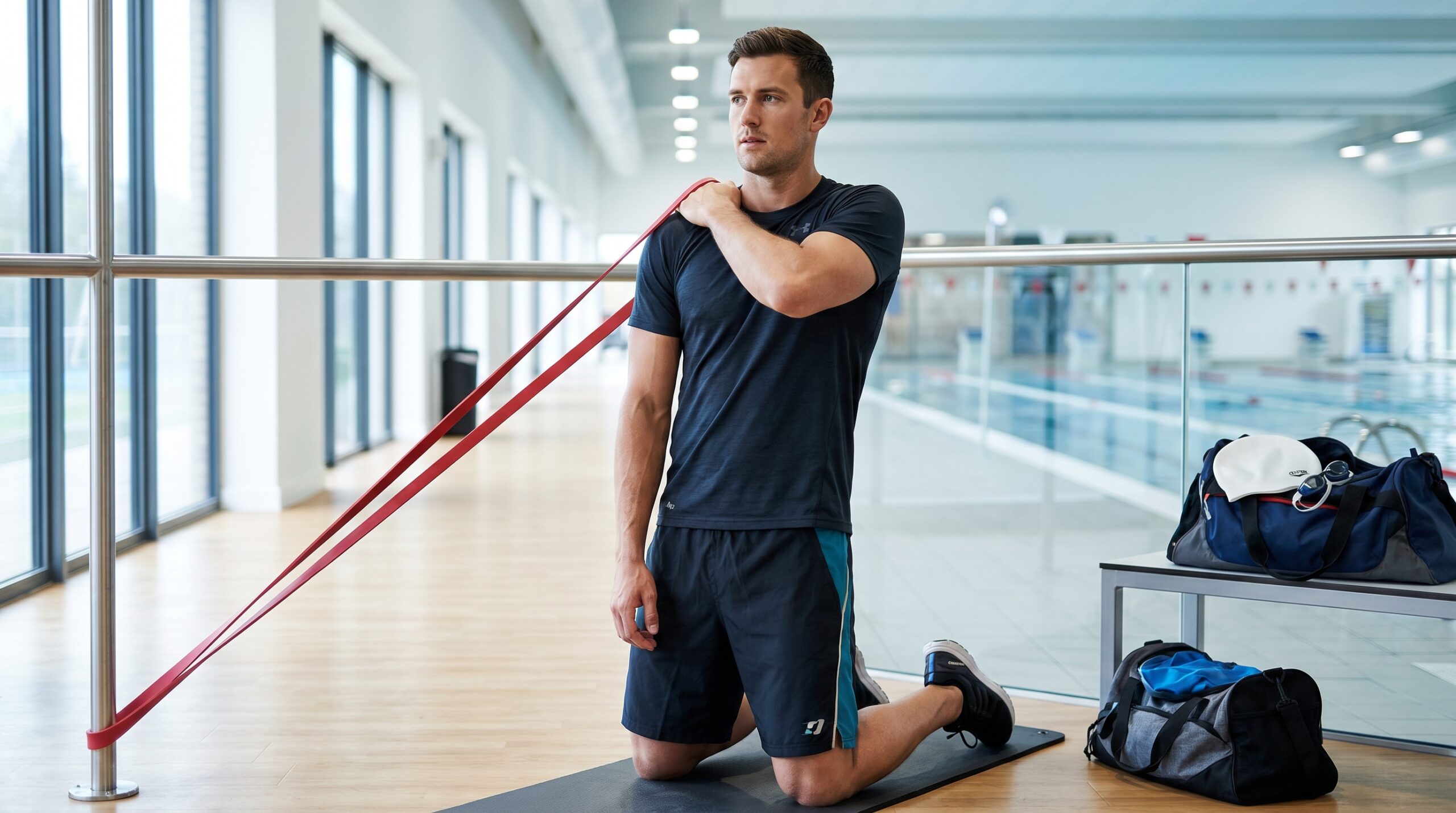
The underwater pull phase is complex. It requires powerful engagement of the latissimus dorsi while keeping the elbow high (the famous “high-elbow catch”). Practicing this technique in the water is difficult because fatigue sets in quickly. Using fitness resistance bands allows you to break down the movement on dry land, become aware of muscle activation, and build kinesthetic memory.
Here’s how to perform a specific strengthening exercise:
- Attach your resistance band to a fixed anchor point (such as a weight rack post) at hip height.
- Lean forward at a 90-degree angle, keeping your back straight, and grasp both ends of the elastic band.
- Simulate the pull motion of the crawl stroke while keeping your elbows fixed and pointing outward at the start of the motion.
- Pull firmly backward until your triceps are fully extended.
- Controls the return to the starting position to work on the eccentric phase.
If you do this exercise regularly, it will dramatically increase your propulsion power once you’re back in the pool or during your open-water swimming sessions.
Strengthen Your Core with Fitness Equipment
In the water, there’s no solid support. If your core is weak, your legs will sink, creating frontal drag that will slow you down significantly. The transfer of force between your arms and legs invariably goes through your abdominal muscles and the deep muscles of your back. Strong core strength is therefore vital for staying horizontal and hydrodynamic.
The GladiatorFit catalog is full of solutions for building the rock-solid core that swimmers need. Incorporating an ab wheel or a medicine ball into your workout circuits helps you work on anti-extension and controlled rotation—two fundamental aspects of swimming. For example, performing “Russian twists” with a medicine ball mimics the engagement of the obliques required when rolling your shoulders during freestyle. Similarly, using an ab mat to support your lower back during long sets of sit-ups will ensure rock-solid core endurance, preventing you from losing form during the final meters of your workout.
Frequently Asked Questions About Swimming Gear
What equipment do you need to start swimming?
To get off to a good start, the basic equipment includes a chlorine-resistant swimsuit that allows for plenty of freedom of movement, a pair of swimming goggles with an anti-fog coating and silicone seals for visual comfort, and a silicone swim cap. This trio ensures comfort, hydrodynamics, and protection during your first few sessions.
Which swimming accessory should you choose to build upper-body strength?
The pull buoy is the ultimate accessory for building upper-body strength. Placed between the legs, it prevents leg kicks and forces the swimmer to propel themselves using only the strength of their arms, shoulders, and back. To make the exercise even more challenging, you can combine it with swim paddles, which will increase water resistance on your hands, thereby promoting muscle hypertrophy.
How can you train for swimming out of the water?
Dryland training is essential. It focuses on two areas: technical drills using resistance bands to simulate the pull and push phases of the arms, and intensive core strengthening (core stability). The use of medicine balls, Swiss balls, or proprioception boards helps develop the core stability needed to keep the body perfectly aligned and afloat on the water’s surface.
What equipment should you choose for open-water swimming?
Open-water swimming requires specific equipment related to safety and natural conditions. A neoprene wetsuit is often essential for buoyancy and thermal insulation. You’ll also need swimming goggles with tinted or polarized lenses to protect your eyes from the sun’s glare, and a brightly colored inflatable safety buoy attached to your waist so you’re visible to boats and can rest if you get a cramp.
Discover our selection of sports equipment
Find all the equipment you need to reach your goals on GladiatorFit.ch

Other articles


Newsletter
Receive our fitness tips and exclusive offers


