Wall ball guide: exercises and buying advice
If you’re a crosstrainer or looking to take your workouts to the next level, you’ve probably come across the wall ball. This fearsome accessory, often dreaded by athletes during WODs (Workouts of the Day), is nevertheless one of the most effective tools for developing your overall fitness. Throwing a ball at a target is a fundamental movement that tests your endurance, strength and mental strength.
At GladiatorFit.ch, your Swiss e-commerce reference for sports equipment, we know that the right equipment makes all the difference. Whether you’re setting up a home gym or equipping a professional box, your choice of equipment shouldn’t be left to chance. This exclusive hybrid guide has been designed to accompany you from A to Z: from a biomechanical understanding of movement to expert advice on selecting the model perfectly suited to your needs.
What is a wall ball and why include it in your workouts?
Versatile equipment for crosstraining
In concrete terms, a wall ball is an imposing weighted ball, designed specifically to be thrown against a wall at a precise height. Unlike traditional sports balls, it has a large diameter (usually around 35 cm, whatever its weight) that forces you to adopt an open ribcage posture. Often made with a synthetic leather or high-resistance PVC cover, its interior is padded with foam, cotton and weighted fillers, enabling it to effectively absorb repeated shocks against a wall target without bouncing violently.
Incorporating this equipment into your sports routine offers two exceptional advantages. On the one hand, the metabolic aspect is undeniable: chaining throws together makes your heart rate soar, making it a great ally for cardio and fat loss. On the other hand, it’s a great tool for working on your explosiveness. The movement requires you to generate power from your lower body and transfer it seamlessly to your fingertips. It’s the very definition of athletic functionality.
Difference between wall ball, medicine ball and slam ball
It’s easy to get confused between the different weighted balls available on the sports equipment market. However, each one has its own unique characteristics:
- The wall ball: large, relatively flexible and covered in synthetic leather. It’s designed to be thrown high against a wall or target. Its suppleness protects your face on landing and cushions the wall impact.
- The slam ball: much smaller and made of a thick, rigid rubber shell, it’s filled with sand. It has absolutely no dead bounce. As its name suggests, it’s designed to be slammed into the ground with all your might, without the risk of it coming back up in your face.
- The medicine ball: This is the classic model, often used in rehabilitation or traditional muscle strengthening. It’s medium-sized, usually made of hard rubber, and has a slight rebound. It is not ideal for throwing at walls, as its hardness can damage the structure or make the landing painful.
How to choose the right wall ball on GladiatorFit?
Select the right weight for your level of fitness
The most common mistake when buying a weighted ball is to assume its strength. Target throwing is a strength endurance exercise. A weight that feels light in your hands will become a burden after 50 repetitions. At GladiatorFit.ch, we offer a wide range of weights, from 4 kg to 15 kg, to meet the needs of all Swiss athletes.
Here are our recommendations to help you choose:
- 4 kg to 5 kg: Ideal for beginners, as a warm-up or to work specifically on movement technique without joint stress.
- 6 kg: This is the standard (RX) competition weight for women in the majority of functional fitness competitions, including Hyrox events.
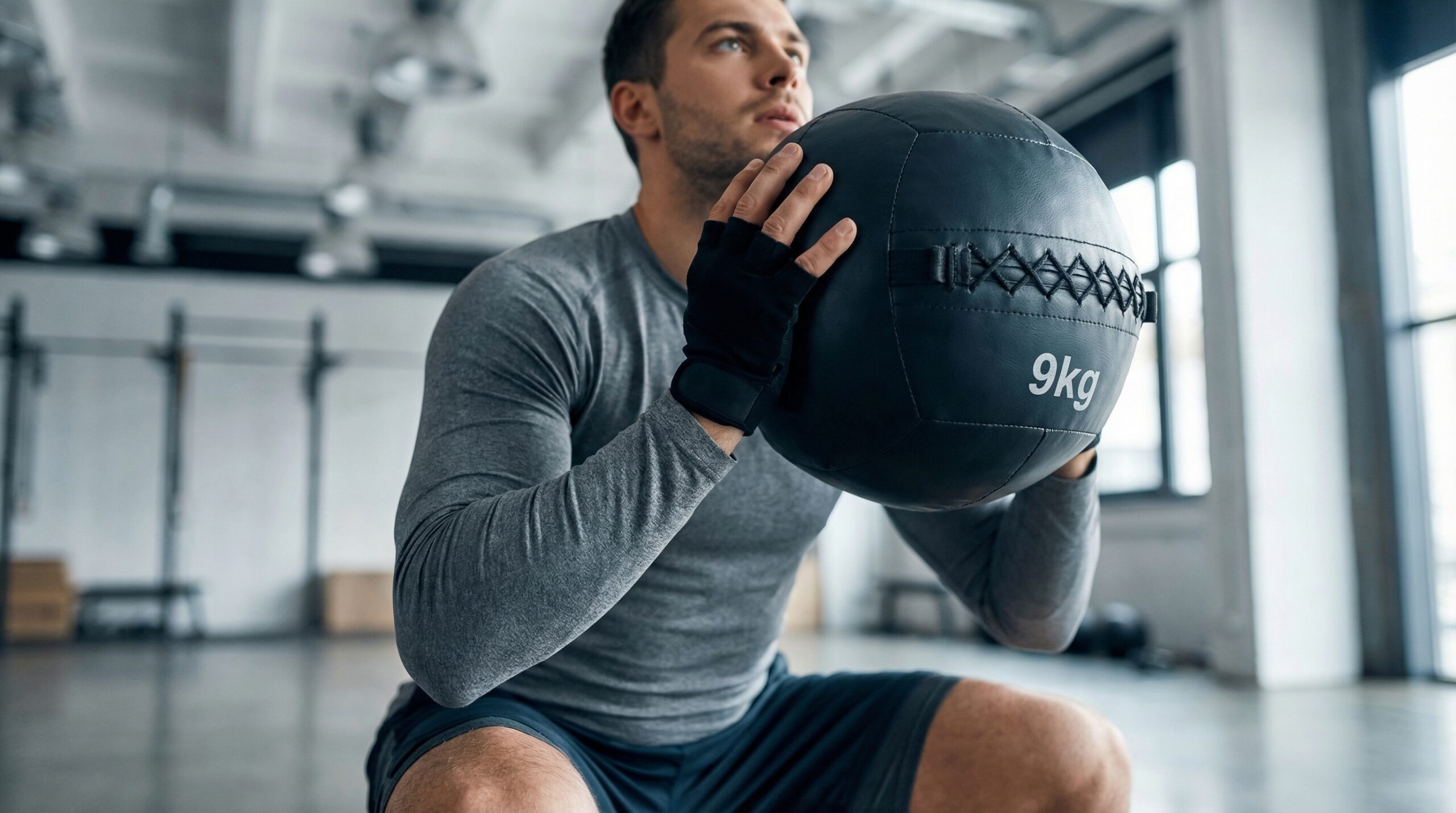
- 9 kg: This is the reference standard weight (RX) for men. It’s the essential choice if you want to prepare for the official standards of world competitions.
- 10 kg to 15 kg: Reserved for advanced and elite athletes looking to overload their training to develop extraordinary explosive strength. Returning to a 9 kg ball after training with a 12 kg model will make you feel like you’re throwing a feather.
The importance of materials and finishes
When it comes to this type of equipment, durability is the number one criterion. A ball that tears and leaks its padding in the middle of a workout is every athlete’s worst fear. That’s why, on our Swiss GladiatorFit website, we rigorously select our products.
A good ball must be designed with a high-quality synthetic leather cover or thick vinyl. This material offers the perfect balance: it’s tough enough to withstand abrasion from the wall and perspiration from your hands, while offering a lightly textured, non-slip surface to ensure good grip when landing.
And pay particular attention to the seams. Top models feature double or even triple nylon-reinforced seams. The lacing must be firmly sealed. It’s this engineering that ensures the ball retains its spherical shape, even after thousands of impacts, avoiding an internal weight imbalance that would make your throws asymmetrical. Don’t hesitate to browse our online catalog to find the equipment that will accompany you for years to come.
Which muscles work with a wall ball?
The reason this exercise is so dreaded is that it’s one of the polyarticular exercises par excellence. It leaves no muscle group at rest, recruiting the entire kinetic chain in a single, fluid movement.
Strengthening the lower body with the squat
The first phase of the movement consists of a deep front squat. During this descending phase, you engage the whole of your lower limbs. The quadriceps are called upon to control the descent and slow down the inertia of the ball. As you reach the bottom of your flexion (the hollow of the hip passing below the knee line), your glutes and hamstrings take over to store elastic energy.
This phase is crucial for strengthening the muscles of the lower body. The stronger your legs, the more power they’ll generate, which will take a considerable load off your arms during the throwing phase.
Engaging the upper body and sheathing
As soon as you start to extend your hips, the energy flows up your body. This is where the magic happens. The push phase powerfully involves your shoulders (front and middle deltoid fascicles), upper pectorals and triceps, which finish the extension to propel the synthetic leather towards the target.
Between these two blocks (upper and lower body), your abdominal muscles act as the transmission bridge. Your sheathing, including your abdominal and lumbar muscles, must remain 100% contracted throughout the movement to keep your back straight, prevent the ball from pulling you forward, and ensure optimal force transfer. That’s what makes it such a great calorie burner.
The perfect technique for mastering the wall ball shot
Starting position and receiving the ball
Mastering the technique will not only preserve your joints, it will also save you as much energy as possible so you can explode your times. Here’s the step-by-step tutorial for a perfect throw:
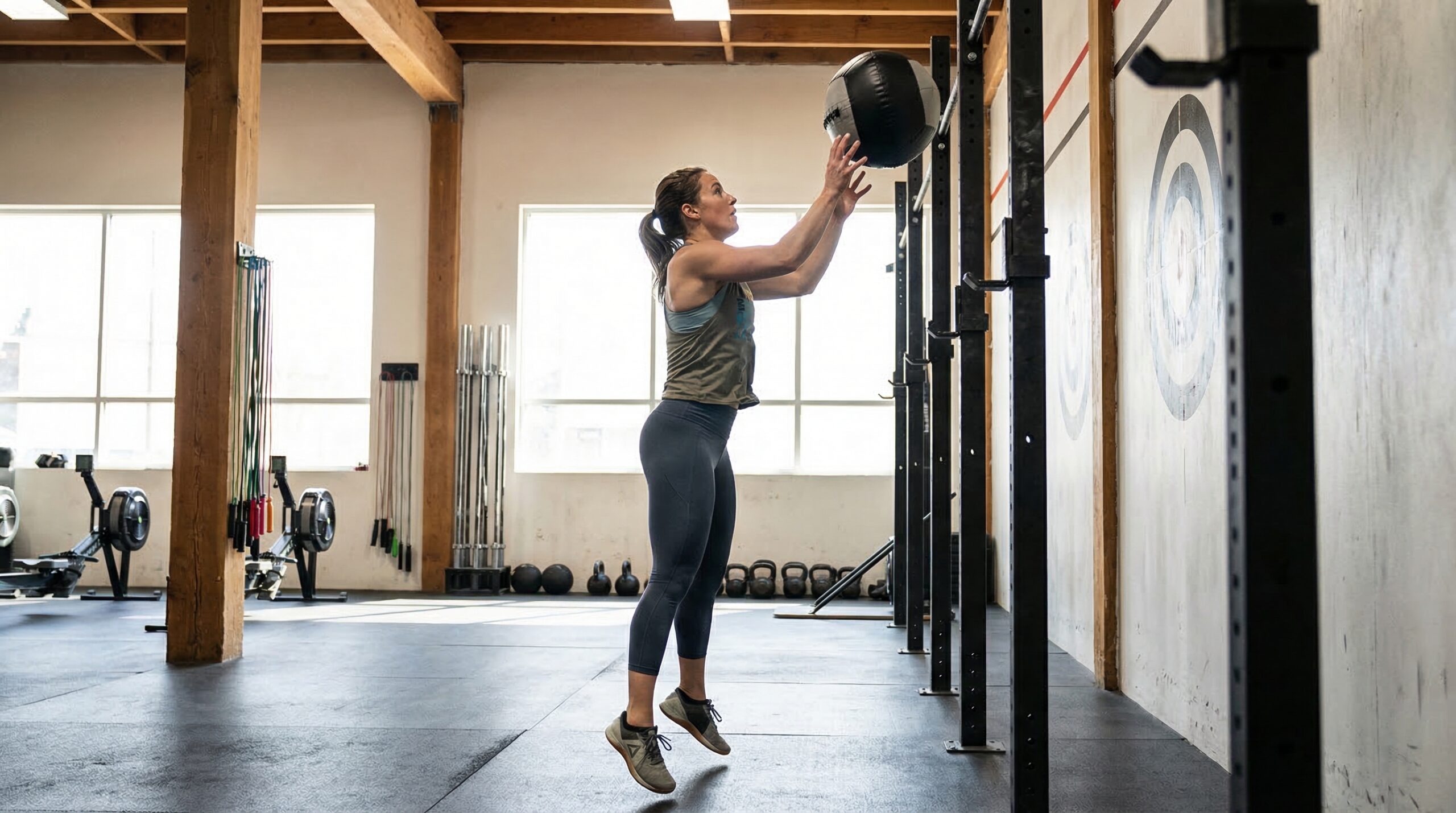
- Placement: Position yourself facing the wall, approximately arm’s length apart (between 40 and 60 cm depending on your biomechanics). Your feet should be shoulder-width apart, with your toes pointing slightly outwards.
- Holding the ball: Grasp the ball at face level (under the chin). Your elbows should be pointed down and tucked under the ball to support it effectively. Keep your gaze fixed on your target.
- Descent: Inhale deeply and initiate your squat by sending your hips back and down. Keep your weight on your heels and your back perfectly straight. Descend until you break the parallel.
- Explosive extension: Pull up vigorously, pushing hard on your legs. The violent extension of your hips will give the ball speed. At the very end of your leg extension, extend your arms to propel the load towards the target. Exhale sharply.
- Landing: Keep your arms in the air while the ball hits the wall. As soon as it comes back down, absorb the impact with your hands and let the weight of the ball carry you naturally and fluidly to your next squat.
Common mistakes to avoid
Even seasoned athletes can see their technique deteriorate as a result of fatigue. Here are the major faults (which often lead to “no-reps” in competition) to be avoided at all costs:
- An incomplete squat: Not going low enough (the famous quarter squat) negates the validity of the movement and deprives you of the power of your glutes.
- Missing the target: Hitting below the official mark is an invalid repeat. Stay focused on your accuracy, even when your heart rate is racing.
- Lowering the ball or your elbows: If you drop your elbows on your knees during the squat, or if the ball is lowered to your stomach, your back will become rounded. This is the best way to lose forward balance and injure your lower back.
- Pushing with the arms too early: The throw should only start once your hips are fully extended (open). If you use your front arms, you’ll wear out your shoulders in just a few repetitions.
- Catching the ball while standing creates a terrible shock for your shoulders and neck. Think of cushioning the impact by directly starting the descent of the squat.
Frequently asked questions about using the wall ball
What is a wall ball?
A wall ball is a large fitness accessory, usually made of sturdy synthetic leather. Filled with foam and weighted materials, its design absorbs impact without uncontrollable rebound. It is mainly used in crosstraining to be thrown at a target fixed high up while performing a deep squat, creating a formidable metabolic workout.
Which muscle does the wall ball work?
This is one of the most complete polyarticular exercises. The squat phase intensively recruits the lower body (quadriceps, glutes, hamstrings and calves). The throwing phase powerfully recruits the upper body (deltoids, upper pectorals, triceps). Finally, the entire abdominal girdle (core and lumbar) works isometrically throughout the movement to stabilize the body and transfer energy.
What height for a wall ball?
International standards set target height according to category. For men, the center of the target must be at a height of 3.05 meters (10 feet). For women, the standard target height is 2.74 metres (9 feet). Training at these specific heights prepares you ideally for official competitions.
How heavy is a Hyrox wall ball?
In a Hyrox competition, the weight of your equipment depends on your race category. For the “Open” category, women generally use a 4 kg ball and men a 6 kg ball. For the “Pro” category, on the other hand, the standard goes up: the weight is set at 6 kg for Pro women and 9 kg for Pro men. These weights demand excellent endurance, with the event often counting 100 repetitions to close the race.
As sports equipment experts, we regularly receive questions from athletes looking to optimize their performance. Here are the precise answers to perfect your knowledge.
Now that you know all the secrets of this devastating movement, all you have to do is take action. Incorporating this exercise into your program is guaranteed to increase your stamina and power, and forge a mind of steel. Don’t wait any longer and discover our selection of premium weighted balls on GladiatorFit.ch. Equip yourself with equipment designed for performance, and get ready to push back your limits!