


hyrox equipment: complete list for your preparation
In just a few years, the Hyrox has become the global fitness phenomenon, combining running and functional exercise in an accessible yet demanding competition format. Whether you’re an experienced hybrid athlete or preparing for your very first race, your choice of equipment is crucial. Unlike other disciplines, this competition is standardized: weights, distances and exercises are always the same. This means that with the right hyrox equipment, you can replicate race conditions exactly at home or in your gym.
To perform on the big day, it’s not enough to just run. You need to master the 8 stations that punctuate the miles of running. In this comprehensive guide, we’ll review all the equipment you need to turn your garage gym or box into an official training center, backed by the professional quality of the GladiatorFit Swiss catalog.
Must-have cardio machines for hyrox
Running accounts for around 50% of the effort at a Hyrox event, but the cardio machines (ergometers) are strategic events where precious minutes can be gained or lost. These stations require impeccable technique and specific effort management.
The rowing machine for muscular endurance
The rowing machine is station number 5 in the race. After you’ve already run 5 km and performed 4 strength tests, you’ll have to cover 1000 meters on this machine. The rowing machine uses more than 80% of the body’s muscles and tests your muscular endurance.
For optimum preparation, it’s crucial to train on reliable equipment that offers air resistance similar to competition standards. The aim is to learn how to manage your pace under fatigue. A good rowing machine should enable you to track your watts and strokes per minute accurately. At GladiatorFit, we offer robust models designed to handle high training volumes without faltering.
Incorporating the rowing machine into your hyrox physical preparation sessions will not only improve your cardio, but also strengthen your posterior chain and sheathing, essential for going the distance.
The ski trainer for the upper body
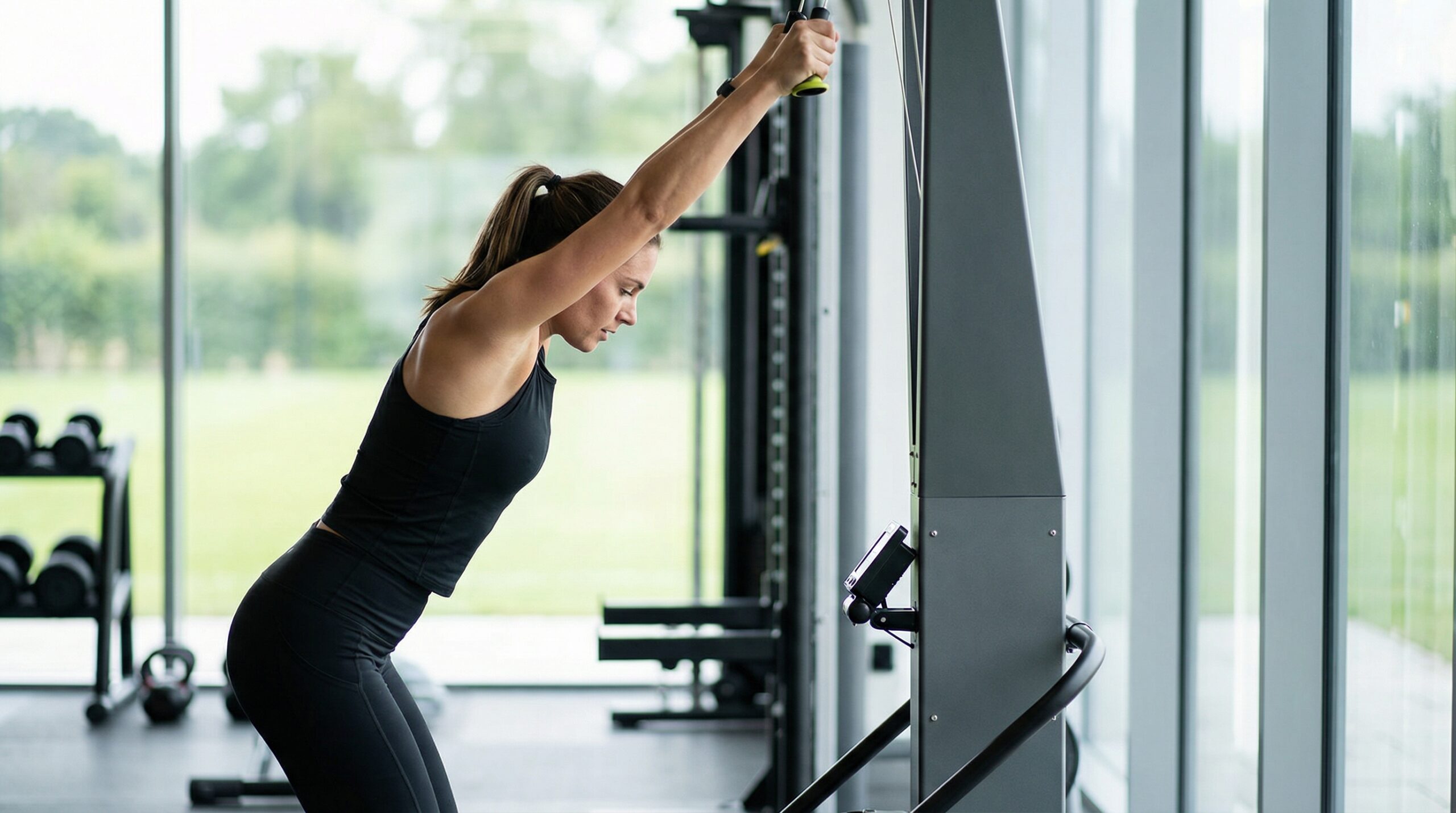
The SkiErg (or ski trainer) is the very first station of the race (Station 1), just after the first kilometer of the run. You’ll have to cover 1000 meters. It’s a race that gets your heart rate soaring, and quickly congests your triceps, shoulders and back.
Having a ski trainer at your disposal is a major asset. Many beginners neglect this machine, thinking that the technique is intuitive. This is a mistake. Poor technique on the ski trainer leads to premature arm fatigue before you’ve even tackled the rest of the race. Training on this machine should focus on using body weight and engaging the abdominals to pull the handles down, rather than relying entirely on arm strength.
Treadmill or outdoor running?
Although running is usually done on an indoor circuit at events, training can vary. If you’re lucky enough to have a professional treadmill (motorized or curved), you can work on your “machine-to-run” transitions more easily. This is what we call “brick” training: going from intense muscular effort to running with no rest time.
However, there’s no substitute for actual running to work on your stride. The ideal is to combine the two:
- Treadmill sessions to work on specific paces and post-fatigue intervals.
- Outdoor outings for volume and fundamental endurance.
The important thing is to get your legs used to running again after your thighs have been burned by the sled push or lunges.
Muscular strengthening: sleds and free weights
This is where the Hyrox differs from simple running. Strength events demand BRUTE power and high lactic resistance. To work these aspects, you need heavy, resistant equipment.
Sled push and sled pull: the queen event
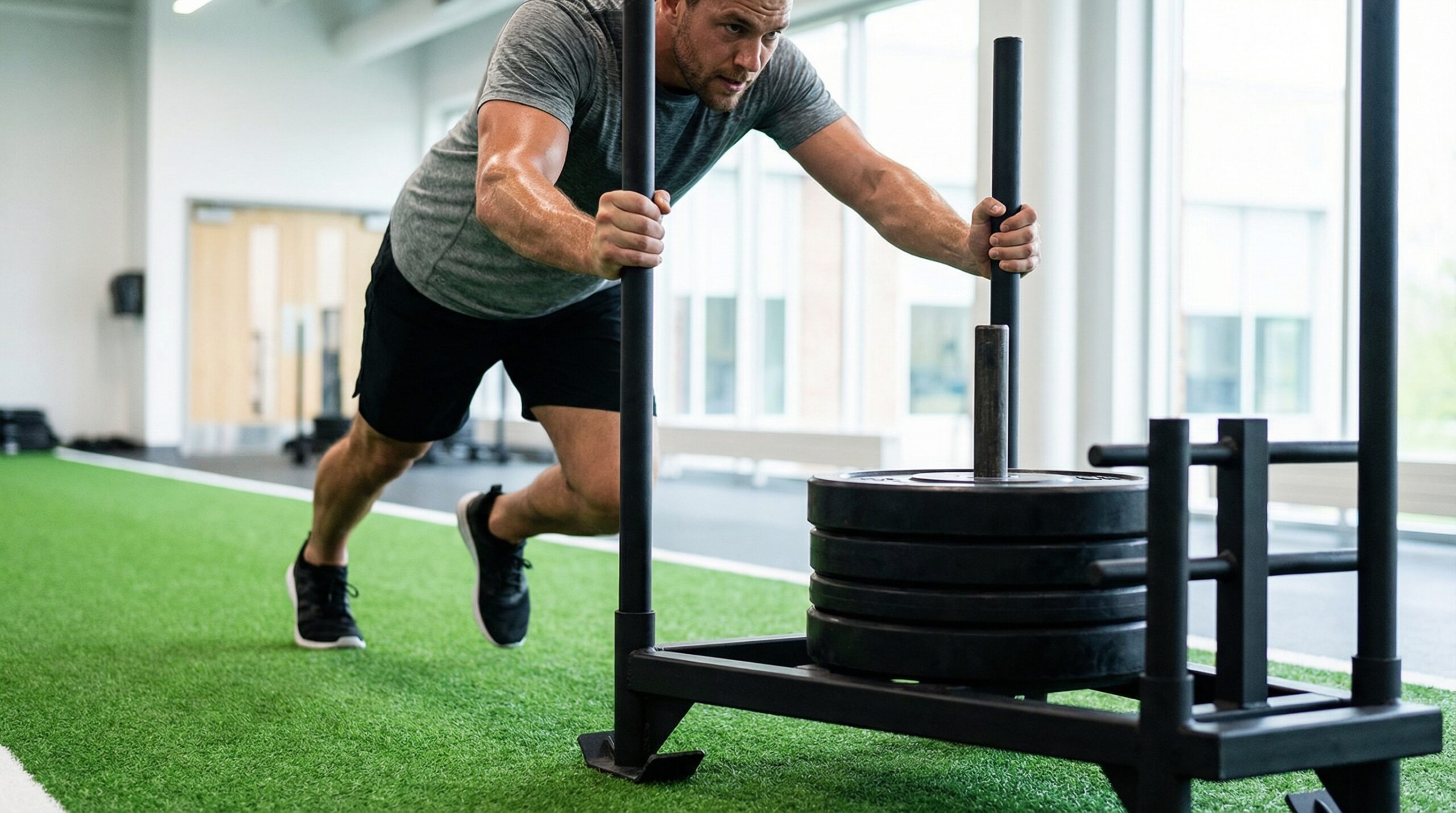
The sled push and sled pull are often regarded as the judges of the competition. These are stations 2 and 3. They require explosive leg strength and rock-solid cardio.
To train at home, you need two inseparable elements:
- Sled: Choose a sturdy model on which you can stack Olympic discs. It should be stable and allow for different grips (high and low).
- A synthetic track: Pushing a sled over concrete or conventional rubber just doesn’t offer the same glide as competition synthetic turf. To replicate the exact effort, installing a strip of synthetic turf in your training area is a wise investment.
Sled training is the essence offunctional training. There’s no cheating: it’s you against the friction. Make sure you have enough discs (bumpers or cast iron) to reach competition weights (up to 152 kg for push and 103 kg for pull in the Pro Men category, sled included).
Kettlebells for farmer's carry
The farmer carry is station 6, and involves carrying two kettlebells (one in each hand) over a distance of 200 metres. The difficulty lies in the strength of the grip and the ability to maintain a sheathed posture under the load.
The standard competition weights are :
- Women: 2 x 16 kg
- Men: 2 x 24 kg
- Pro Women: 2 x 24 kg
- Pro Men: 2 x 32 kg
At GladiatorFit.ch, we prefer cast-iron kettlebells with a wide, textured handle for a good grip. Training with loads slightly higher than those used in competition can give you a significant psychological and physical advantage.
Sandbags for weighted slots
Sandbag lunges are station 7, often dreaded as they come late in the race. You have to run 100 meters with a bag on your shoulders (10, 20 or 30 kg, depending on the category).
Why use a specific sandbag and not a bar? Because sand is unstable. The bag moves, slips and requires constant adjustment of your posture. For your training, it’s imperative to have professional-quality sandbags, with reinforced seams and secure fastenings. Nothing’s worse than a bag that leaks in the middle of a workout. Choose cylindrical models (“worm” or “power bag”) that sit well on the trapezius.
Functional exercises and explosiveness
Finally, the Hyrox tests your explosiveness and your ability to move your own body in space, often in a state of advanced pre-fatigue.
Wall balls: choosing the right weight and target
Station 8, the last one before the finish line, is the Wall Ball. You have to do 75 or 100 repetitions. It’s as much a mental test as a physical one.
The standard is precise:
- Women: Wall ball 4 kg (Open) or 6 kg (Pro), target at 2.75 m (9 feet).
- Men: 6kg wall ball (Open) or 9kg wall ball (Pro), target at 3.05 m (10 feet).
For your training, make sure you buy a ball that absorbs shock well and retains its round shape as you throw it. At GladiatorFit, our wall balls are designed to withstand the thousands of repetitions you’ll need to prepare. Don’t forget to mark the height of the target on your wall, or to install a metal target on your rack, so that you can scrupulously validate each repetition.
Burpees broad jumps: mats and protection
Station 4 is the 80-meter Burpee Broad Jump. Unlike crosstraining, where you often do burpees on the spot, here you have to jump forward as far as possible with each rep.
This exercise is traumatic for the joints (wrists, knees) because of the repeated impacts on the floor. If you’re training in a garage or an area with a hard floor, the use of rubber floor tiles (such as shock-absorbing tiles) or a thick yoga mat for the starting area is highly recommended. This will protect your joints and enable you to continue training without unnecessary injury. What’s more, a good pair of knee pads can be a useful addition to your outfit for this specific event.

Preparing for a fitness competition like the Hyrox requires rigor and the right equipment. When you buy from GladiatorFit, you’re guaranteed tested and approved equipment capable of withstanding the intensity of your preparation. Ready to turn your potential into performance?
Faq: everything you need to know about hyrox preparation
What equipment for hyrox?
For complete Hyrox preparation, the essential equipment includes: a rowing machine and ski trainer (ideally Concept2 or equivalent), a treadmill (if outdoor running is not possible), a sled with rope and weights, kettlebells (pairs of 16, 24 or 32 kg), a sandbag (10, 20 or 30 kg) and a wall ball (4, 6 or 9 kg). Access to a synthetic track is a big plus for sled training.
How to wear hyrox?
The ideal outfit for the Hyrox should be breathable and close-fitting, to avoid impeding movement. Choose compression shorts or leggings to limit chafing. The choice of shoes is crucial: they must offer excellent cushioning for the race (8 km in total), but also good stability and, above all, optimum grip for the sled push. Running shoes with a gripping outsole (such as Puma, Hoka or specific crosstraining models) are often preferred.
Is hyrox more difficult than crosstraining?
There’s a difference. The Hyrox is a fundamental endurance event punctuated by functional efforts, lasting between 1h and 1h30 for the average participant. The effort is continuous and linear. Crosstraining often focuses on shorter, more explosive and technically more complex efforts (gymnastics, heavy weightlifting). Hyrox is generally more technically accessible (no complex movements such as snatch or muscle-up) but requires extremely high cardio-respiratory endurance.
Discover our selection of sports equipment
Find all the equipment you need to reach your goals on GladiatorFit.ch

Other articles




Newsletter
Receive our fitness tips and exclusive offers


